Environmental Justice and Environmental Crime Awareness at Historically Black Colleges and Universities (HBCUs): Insights from Behavioral Science Researchers

*Corresponding author: Johnny Rice II, Department of Criminal Justice College of Behavioral and Social Sciences Coppin State University Baltimore, MD jrice@coppin.edu
-
Received: ,
Accepted: ,
ABSTRACT
Environmental injustice and environmental crime are critical public health and criminal justice issues that disproportionately affect marginalized communities. This study describes and evaluates an environmental justice–environmental crime initiative implemented by faculty in the College of Behavioral and Social Sciences at Coppin State University in Baltimore, MD, a Historically Black College and University (HBCU). Using a descriptive case study design, data were collected from course records, student assessments, research documentation, and participation logs. The framework engaged undergraduate scholars in a diverse range of student-led research projects. Findings demonstrate improved public health competencies, increased advocacy, and stronger partnerships, highlighting a scalable approach to advancing environmental health equity and workforce development at HBCUs.
Keywords
Environmental Health
Environmental Justice
Environmental Crime
Public Health
Criminal Justice
Marginalized Communities
Historically Black Universities and Colleges (HBCUs)
INTRODUCTION
Environmental injustice and environmental crime disproportionately affect marginalized communities, contributing to preventable disease, ecological degradation, and health inequities.[1,2] Exposure to pollution, hazardous waste, and environmental neglect intersects with social determinants of health, including access to adequate housing, access to healthcare, and food security, as well as long-term community disinvestment.[3] These challenges underscore the need for approaches that connect education, research, policy, and community action.
Historically Black Colleges and Universities (HBCUs) are uniquely positioned to address these challenges through their social justice missions and emphasis on applied learning. Coppin State University, a public HBCUs located in Baltimore, Maryland, provides a practice-based case example of how environmental justice and environmental crime education can be operationalized as translational public health practice. This study presents the school’s behavioral and social science researchers’ four-pillar framework—Education, Research, Advocacy and Activism, and Networking and Collaboration—as a model for translating academic knowledge into community-engaged public health action.
OVERVIEW OF ENVIRONMENTAL JUSTICE AND ENVIRONMENTAL CRIME
Environmental justice is grounded in the principle that all people have the right to live in safe and healthy environments and to participate meaningfully in environmental decision-making that concerns them.[4] National data consistently show that marginalized communities experience disproportionate exposure to conditions like pollution, hazardous waste, and climate-related risks.[5] Over time, activism, research, and policy advocacy have increased public awareness of these inequities and strengthened calls for equitable environmental protections.
Environmental crime—including illegal dumping, pollution violations, wildlife trafficking, and unauthorized resource extraction—is among the fastest-growing criminal industries worldwide, generating more than $280 billion annually.[6] These crimes threaten ecosystems and human health, contributing to asthma, cancer, cardiovascular disease, and other chronic conditions.[6] Environmental crime frequently intensifies preexisting social and economic disadvantages, thereby perpetuating systemic inequities.[7] HBCUs are uniquely positioned to lead efforts to address these challenges, given their longstanding mission centered on social justice and community engagement, and their proximity to affected communities.
METHOD
Setting
Coppin State University is a public HBCUs located in Baltimore, Maryland. It was founded in 1900 and offers 53 undergraduate majors and nine graduate degrees.[8] The university is accredited by the Middle States Commission on Higher Education and serves a predominantly African American student population of 82.99%. Others include foreign/non-resident (6.38%), Hispanic (4.25%), Caucasian (1.76%), Asian (0.68%), American Indian/Alaskan Native (0.5%), Hawaiian/Pacific Islander (0.18%), multi-race (1.18%), and unknown (2.08%).[9] The school’s institutional mission emphasizes leadership, civic engagement, and community involvement.
Study Design
A descriptive case study design was used to document both the implementation process and the resulting outcomes of the researchers environmental justice and environmental crime framework. This approach demonstrated how the framework was developed by researchers in the College of Behavioral and Social Sciences, how it was applied in practice, and its impact on education, research, and community engagement initiatives.
COPPIN STATE UNIVERSITY’S BEHAVIORAL SCIENCE RESEARCHERS FOUR-PILLAR FRAMEWORK
The four-pillar framework [Figure 1] was developed by faculty in the College of Behavioral and Social Sciences to integrate environmental justice and environmental crime across the curriculum in applied research, advocacy, and regional partnerships, to strengthen community capacity to address these challenges.
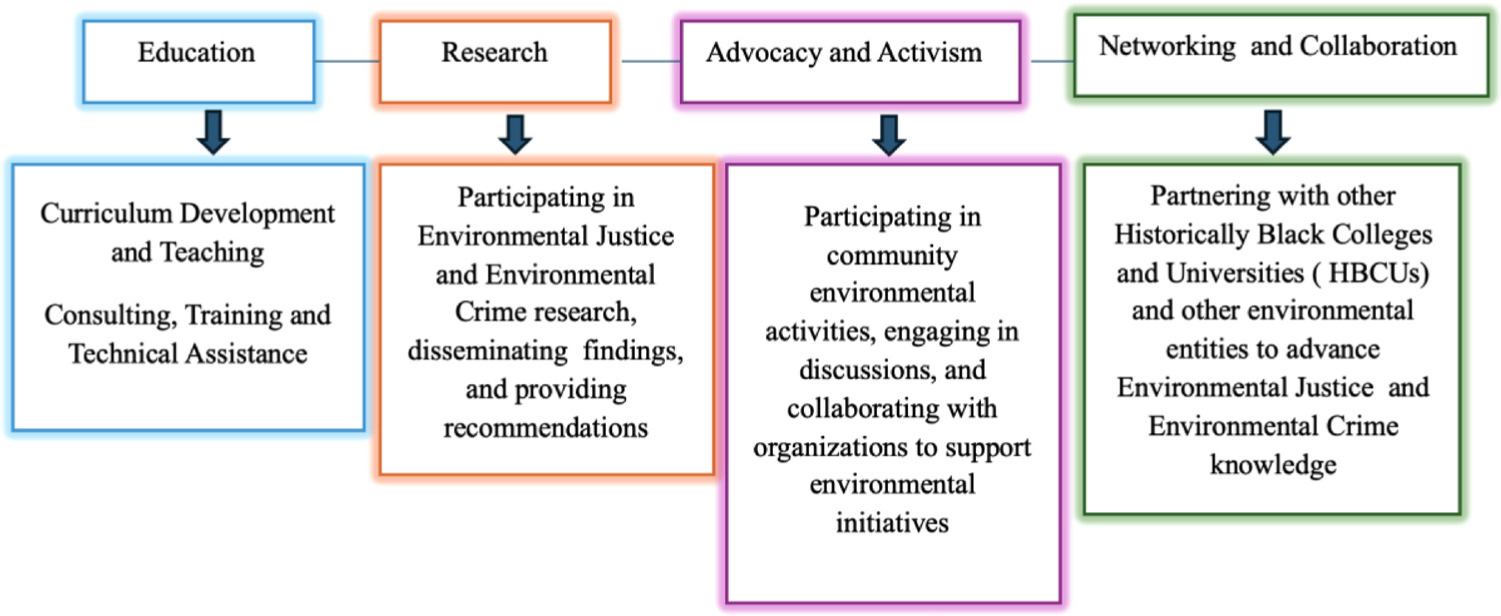
- Coppin State University’s Behavioral Science Researchers Four-Pillar Framework for Promoting Environmental Justice and Environmental Crime Awareness.
Source: Authors.
The framework emphasizes applied learning, interdisciplinary integration, and sustained community engagement. Its effectiveness is demonstrated through student competency-based assessments, research dissemination, and long-term partnerships with community and regional organizations. By aligning teaching, research, advocacy, and collaboration, the framework provides a comprehensive and replicable approach to environmental justice and environmental crime education at HBCUs. The pillars of the framework are explained below:
Education
Curriculum Development and Teaching
Environmental justice and environmental crime concepts were embedded into existing courses across two (2) departments, namely the the Department of Criminal Justice and the Department of Applied Social and Political Sciences. Faculty revised syllabi, assignments, and learning outcomes in classes such as Environmental Crime, Urban Studies, Environmental Planning and Policy, Social Research Methods, Community Organization, and Family Studies. Guest lecturers from Coppin State University, the Baltimore Planning Department, and the West North Avenue Development Authority connected classroom learning to professional practice. Through this approach, more than 400 students examined the impacts of inequitable land use, pollution, and urban disinvestment on health and crime.
Consulting, Training, and Technical Assistance
Faculty extended learning beyond the classroom through consulting, training, and technical assistance provided to community organizations [Figure 2]. Working under faculty supervision, students collaborated with community partners to apply Crime Prevention Through Environmental Design (CPTED) principles and support hazard-mitigation planning. These activities were structured as experiential learning opportunities, enabling students to apply course concepts in real-world settings. At the same time, local organizations benefited from enhanced technical capacity, improved environmental conditions, and support for data-informed planning.
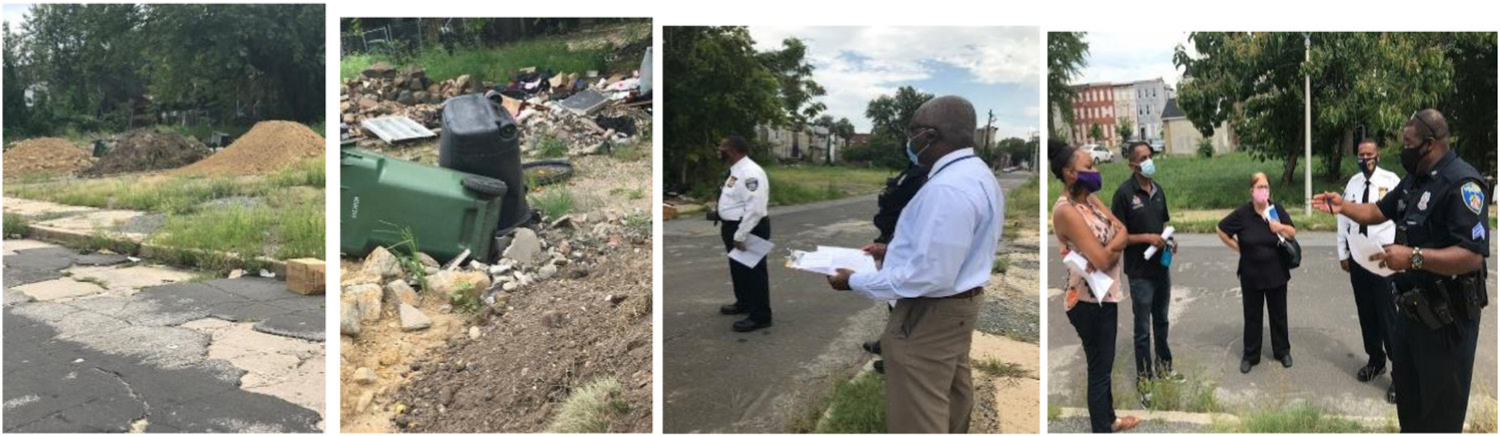
- Coppin State University faculty, student scholar, and community stakeholders’ safety assessment of Cab Calloway Park in West Baltimore (May 2020).
Source: Authors.
The CPTED review of Cab Calloway Park in West Baltimore consisted of an assessment and evaluation of illegal dumping and drug debris in the playground area. Coppin faculty, student experts in law enforcement, community development, and local city housing stakeholders worked collaboratively to identify risks and recommend safety strategies that include signage, imporved lighting and landscaping, and strategic patrols law enforcement patrols. Guidance provided assisted the local church and community residents in responding effectively to loitering and pollution in that specific area.
Research
The research pillar positions student research as an applied practice in public health. The Social Research Method course allows students to address real-world challenges. Faculty provide training in research design. Since 2022, 78 students have completed original research projects addressing social disparities in marginalized communities, thereby strengthening scientific communication skills and expanding the visibility of student-led environmental health research.
Advocacy and Activism
The advocacy and activism pillar links academic knowledge to civic engagement. Faculty organize and partner on environmental town halls, climate and health forums, awareness campaigns, and community cleanups as structured learning experiences. Notable initiatives include the March 15, 2023, HBCU Climate Justice Town Hall at Coppin State University campus hosted by the Alliance for the Chesapeake Bay, which brought together more than 30 attendees, including faculty, staff, and students from some HBCUs, including Bowie State University, Morgan State University, Howard University, the University of the District of Columbia, and the University of Maryland Eastern Shore, to discuss climate justice efforts;. The September 15, 2023, Jones Falls Trail and Horseshoe Falls cleanup, also hosted by the Alliance for the Chesapeake Bay, saw volunteers from Coppin State University and Bowie State University remove 225 pounds of trash. These activities reinforce the recognition of environmental justice and environmental crime as public health priorities and strengthen students’ advocacy and leadership skills.
Networking and Collaboration
The Networking and Collaboration pillar was implemented through strategic, sustained partnerships. Regional summits and forums were used as structured learning and professional development opportunities. Coppin State University’s consistent participation in the HBCU/MSI Chesapeake Bay Summits strengthened institutional visibility and leadership. In 2023, three faculty members and one student attended the Pioneer Summit in Centreville and North Bay, Maryland (September 9–10). In 2024, two faculty members and four students participated in the summit held September 7–8 at North Bay, Maryland [Figure 3].
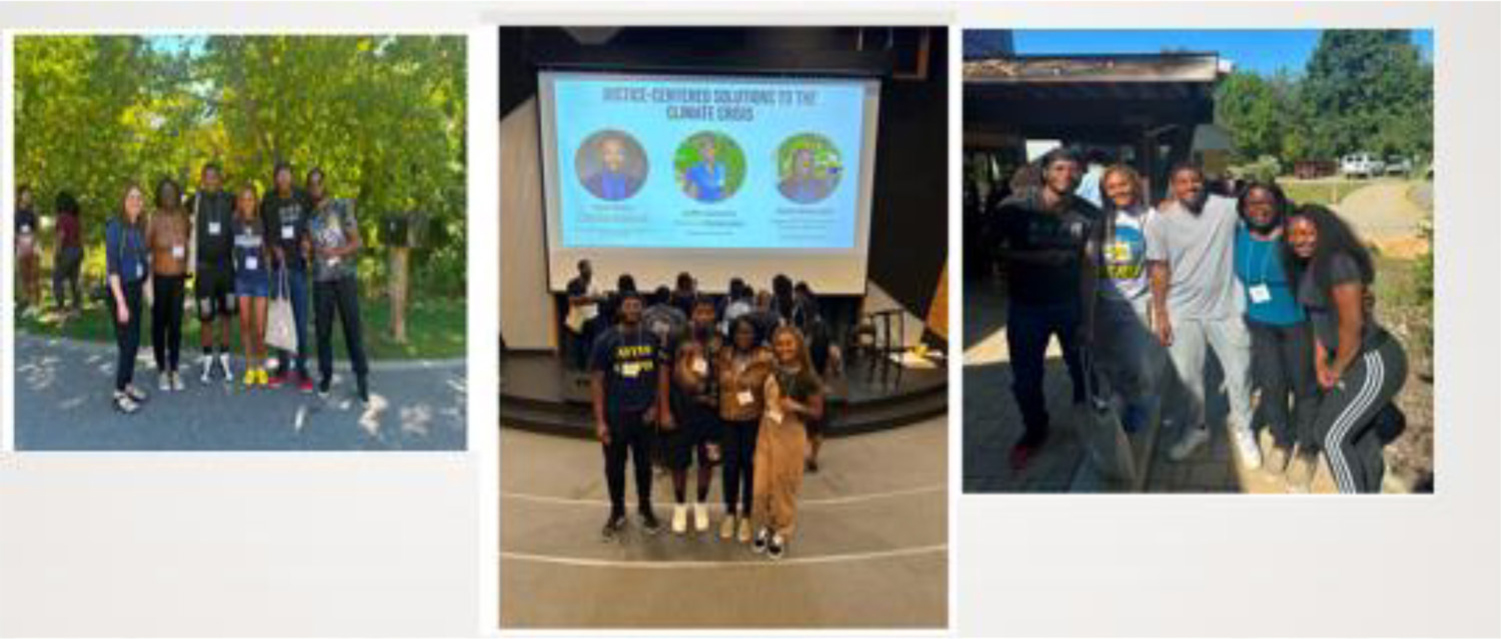
- Coppin State University faculty, student scholars at the HBCU/MSI Bay Summit (September 2024).
Source: Authors.
In October 2023, three (3) students and two (2) faculty members participated in the watershed forum in Shepherdstown, WV, while two (2) faculty members and four (4) students attended the same event in October 2024. Through these collaborations, students gained hands-on experience in environmental restoration, watershed management, and sustainability. Collectively, these partnerships reinforce the university’s role in community development and illustrate a holistic framework in which education, research, advocacy, and collaboration work together to build environmental health literacy.
Data sources included course enrollment records, student competency-based assessments, documentation of research projects and dissemination activities, participation logs from advocacy and networking events, and faculty program reports. Outcomes focused on student engagement, applied public health competencies, research outputs, and partnership development.
DISCUSSION
This case study illustrates how a structured, faculty-developed framework can translate environmental education into applied public health practice. By integrating education, research, advocacy, and collaboration, HBCUs can strengthen environmental health literacy and deepen students’ understanding of environmental determinants of health and structural inequities. Student participation in community-based research and advocacy fostered practical competencies relevant to criminal justice and public health; regional partnerships further enhanced translational learning by connecting academic instruction to real-world environmental initiatives. Overall, the framework advances the goals of translational public health by moving knowledge from the classroom into community settings, while underscoring the need for sustained institutional commitment and external investment to ensure the long-term viability of environmental initiatives.
Emerging Threats
One of the major challenges facing HBCUs is funding. Based on current federal government priorities, there are significant concerns regarding funding reductions in environmental initiatives. Such policy shifts, including rollbacks of efforts to address chemical exposures and other sources of environmental contamination, will have an immediate detrimental effect on marginalized populations and significantly limit research.
Recommendations for other Historically Black Colleges and Universities
Advancing environmental justice and environmental crime education at HBCUs requires increased federal and state investment to support community-based programs and research; stronger academic–community partnerships to enhance training and local problem-solving; structured workforce pipelines that include internships, fellowships, and job placements; the integration of public health perspectives into urban revitalization planning; and support for environmental entrepreneurship to foster innovative, community-centered solutions.
Lessons Learned
1. Consultation and training extend academic knowledge beyond the classroom into real-world application, strengthening both student learning and community capacity.
2. Advocacy activities increased civic engagement and environmental stewardship.
3. Community-based research deepened learning and improved public health skills.
4. Regional partnerships expanded students’ professional exposure while increasing institutional visibility and credibility.
CONCLUSION AND IMPLICATIONS FOR PRACTICE
Sustained investment in environmental research is essential for HBCUs to expand and sustain environmental initiatives. These investments enable institutions to build faculty capacity, support student-led research, and maintain long-term partnerships with communities most affected by environmental inequities. Coppin State University’s four-pillar framework provides a scalable, adaptable model for integrating environmental justice and environmental crime across teaching, research, advocacy, and collaboration. Collectively, these efforts equip the next generation of public health and environmental leaders with the technical skills, ethical grounding, and civic commitment needed to address complex environmental challenges at the local, regional, and national levels.
Acknowledgments
Coppin State University College of Behavioral and Social Sciences; Baltimore Police Department; Druid Heights Community Development Corporation; Baltimore City Department of Housing and Community Development; Baltimore City Planning Department; and Alliance for the Chesapeake Bay.
COMPLIANCE WITH ETHICAL STANDARDS
Conflicts of Interest: Dr. Rice serves as an Editorial Board Member for IJTMRPH. He was entirely excluded from the editorial and peer-review processes for this manuscript. The authors declare no other competing interests. Financial Disclosure: Nothing to declare. Funding/Support: There was no funding for this study. Ethics Approval: Not applicable. Declaration of Patient Consent: The authors certify that they have obtained all appropriate consent. Use of Artificial Intelligence (AI)–Assisted Technology for Manuscript Preparation: The authors confirm that there was no use of Artificial Intelligence (AI) – Assisted Technology for assisting in the writing or editing of the manuscript, and no images were manipulated using the no Artificial Intelligence (AI)–Assisted Technology was used in the writing or editing of the manuscript, and that no images were manipulated using AI. Disclaimer: None.
Key Messages
1. Environmental justice and environmental crime education can be integrated into HBCU curricula through education, research, advocacy, and community partnerships. 2. The Coppin State University College of Behavioral and Social Sciences model provides a scalable approach that other Historically Black Colleges and Universities can adapt to prepare the next generation of environmental professional.
REFERENCES
- Advancing environmental justice education: a critical review of research and practice. Environ Educ Res. 2025;31(7):1461-80.
- [Google Scholar]
- Understanding environmental justice and human flourishing: perspectives of undergraduate social work students. Social Work Christ. 2025;51(4):418-34. doi: 10.34043/gt61rr34
- [Google Scholar]
- School projects with the community: educational practices that promote connection between learning contexts and experiences. Acta Psychol. 2025;255:104893. doi: 10.1016/j.actpsy.2025.104893
- [Google Scholar]
- Realization of the right to environment protection as a fundamental right in the United States: some reflections. Environ Policy Law. 2025;55(4-5):138-51. doi: 10.1177/18785395251364735
- [Google Scholar]
- Fossil fuel racism in the United States: how phasing out coal, oil, and gas can protect communities. Energy Res Soc Sci. 2023;100:103104. doi: 10.1016/j.erss.2023.103104
- [Google Scholar]
- The effects of environmental factors on general human health: A scoping review. Healthcare (Basel). 2024;12(21):2123. doi: 10.3390/healthcare12212123.
- [Google Scholar]
- Health effects at the intersection of climate change and structural racism in the United States: a scoping review. J Clim Change Health. 2024;20:100339. doi: 10.1016/j.joclim.2024.100339
- [Google Scholar]
- The history of Coppin State University. Baltimore (MD): Coppin State University; 2026. [cited 2025 Dec 13]. Available from: https://www.coppin.edu/csu-history
- [Google Scholar]
- Coppin State University. Baltimore (MD): Coppin State University; 2025. [cited 2025 Dec 13]. Available from: https://www.coppin.edu/research/center-strategic-entrepreneurship-cse
- [Google Scholar]