
The Role of Health Belief Model in HIV Screening Decision among International Students in the United States: A Pilot Study
DOI:
https://doi.org/10.21106/ijtmrph.99Keywords:
- HIV,
- HIV screening,
- Decision,
- Acceptance,
- Perceived Benefit,
- Perceived Threat,
- Perceived Susceptibility,
- Health Belief Model,
- International Students
Abstract
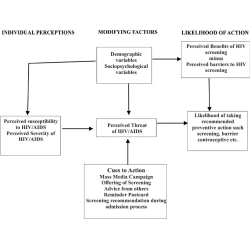
Objectives: We sought to determine how the Health Belief Model (HBM) constructs relate to Human Immunodeficiency Virus (HIV) screening decisions among international students and which of the HBM constructs was most relevant in those screening decisions. Methods: We conducted a cross-sectional pilot study using an online survey of international students at Western Illinois University in the United States. Participants signed electronic informed consent. The online survey comprised of questions that assessed their sociodemographic characteristics, acceptance of HIV screening, and perceived knowledge of HIV. The survey also determined the role of perceived benefits, perceived threat, and cues to action in making HIV screening decisions among the study population. Results: Four hundred and ninety students were invited to participate in the survey out of which 185 responses were obtained. In all, 107(57.8%) were males, and 78(42.8%) were females. Most of the respondents were from Asia (64.9%) and Africa (24.9%). The prevalence of acceptance of HIV screening among international students was found to be 73.5%. About 90% of the participants perceived HIV screening to be beneficial to their health, and 76% of them would accept the screening because they were offered. The majority (83%) of participants who said that they would not accept HIV screening, were also not sexually active, and they did not think they could be susceptible to HIV. Conclusion and Implications for Translation: Perceived benefits and cues to action were found to be the significant factors that informed the decision of people who accepted to be screened for HIV. Perceived susceptibility informed the decision of those that rejected the screening. Caution is warranted in generalizing the findings from this study because of the limited sample size; however, we are confident that our findings are reproducible in a larger population context.
Downloads
Similar Articles
- Ashok Bahadur Varma, Can the Internal Nasal Valves Method Be a Game Changer for Preventing Respiratory Tract Infections? , Vol. 8 No. Continuous (2024): The International Journal of Translational Medical Research and Public Health (IJTMRPH)
- Bushra Elbashir, Msab Al-dkheel, Hamad Aldakheel, Naif Aruwished, Nasser Alodayani, Hypertension in Saudi Arabia: Assessing Life Style and Attitudes , Vol. 4 No. 1 (2020): The International Journal of Translational Medical Research and Public Health (IJTMRPH)
- Omar M Young, Jackyln C Fuller, Henry W Lewis III, An Innovative Approach to E-mentorship for Black Applicants to Graduate Medical Education (GME) Programs , Vol. 8 No. Continuous (2024): The International Journal of Translational Medical Research and Public Health (IJTMRPH)
- Angelique B Willis, Mildred Addo, Lauren E Yoder, Cassandra K Johnson, Sydney L Resler, Leticia J Young, Elizabeth Armstrong-Mensah, Individual and Community Level Factors Related to Sanitation, Water Quality, Treatment and Management in Rural Communities in Accra, Ghana: A Field Study Report , Vol. 6 No. 1 (2022): The International Journal of Translational Medical Research and Public Health (IJTMRPH)
- Faruqueuddin U. Ahmed, COVID-19 Pandemic and Medical Education in India , Vol. 5 No. 1 (2021): The International Journal of Translational Medical Research and Public Health (IJTMRPH)
- Deepa Dongarwar, Brisa Y Garcia, Sitratullah O Maiyegun, Korede K Yusuf, Hamisu M Salihu, COVID-19 Early Vaccination Rates and Gross Domestic Product Per Capita , Vol. 5 No. 1 (2021): The International Journal of Translational Medical Research and Public Health (IJTMRPH)
- Vinod K Ramani, Radheshyam Naik, A Narrative Review of the Pathophysiology of Mucormycosis Infection Among COVID-19 Patients in India: Epidemiology and Clinical Implications , Vol. 6 No. 1 (2022): The International Journal of Translational Medical Research and Public Health (IJTMRPH)
- Leah Claus, Sara S Jarvis, Building Trust: Strategies for Recruiting Underrepresented Populations in Research during the COVID-19 Pandemic , Vol. 7 No. 1 (2023): The International Journal of Translational Medical Research and Public Health (IJTMRPH)
- Anushka Banerjee, Abhijit G. Banerjee, Chronic Inflammation in Polycystic Ovarian Syndrome: Examining Biomarker–Driven Control Strategies to Reduce Population–Level Disease Burden , Vol. 8 No. Continuous (2024): The International Journal of Translational Medical Research and Public Health (IJTMRPH)
- Marilyn Murrillo, On Utilizing Artificial Intelligence to Impact Healthcare in Low-Income Countries , Vol. 8 No. Continuous (2024): The International Journal of Translational Medical Research and Public Health (IJTMRPH)
<< < 8 9 10 11 12 13 14 15 > >>
You may also start an advanced similarity search for this article.
Published
How to Cite
Issue
Section
License
Copyright © 2020 Oluwasola Stephen Ayosanmi, Lorette Oden, Titilope Ayosanmi, Babatunde Alli, Mei Wen, Jamie Johnson. Published by Global Health and Education Projects, Inc., USA.

This is an open-access article distributed under the terms of the Creative Commons Attribution-NonCommercial-ShareAlike 4.0 International License , which permits others to remix, transform, and build upon the work non-commercially, provided the original author is credited and the new creations are licensed under the same terms.



 .
.

