
Disparities in Urban and Rural Dwelling Adolescents’ Educational Needs for Obesity Prevention in Nigeria
DOI:
https://doi.org/10.21106/ijtmrph.177Keywords:
- Adolescent,
- Obesity Prevention,
- Bayelsa State,
- Niger Delta,
- Nigeria
Abstract
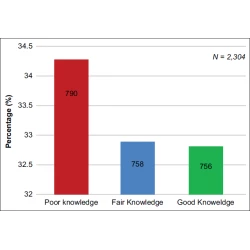
Background and Objectives: Obesity has increased in recent times and has attained an epidemic status worldwide, incuding in Nigeria. Prevalence of obesity rises during adolescence and prevention is advantageous. However, it is unknown whether rural and urban dwelling adolescents in Bayelsa State in the Niger Delta region of Nigeria have the requisite knowledge needed to prevent obesity. The objective of this study was to determine the educational needs of urban and rural dwelling adolescents for obesity prevention. Methods: The study was a school-based cross-sectional survey, and employed multistage sampling technique to select six secondary schools across the three senatorial districts of the state. An adapted and validated sub-scaled obesity knowledge questionnaire was used to obtain data from 2,304 secondary school students. Statistical Package for Social Sciences (SPSS) version 23.0 was used for data analysis. Results: The total number of urban male students and rural male students was 576 (25.00%). The total number of urban female students and rural female students was also 576 (25.00%). The sample mean age of participants was 16.77 (SD±79), and those aged 16 years 1,043 (45.27%) were the largest portion of the sample. Generally, 756 (32.81%) of the participants had good knowledge of obesity. Specifically, subscale analysis showed that 622 (27.00%) participants had good knowledge of risk factors for obesity; 519 (22.53%) had good knowledge of complications of obesity; 659 (28.60%) had good knowledge of prevention for obesity; and 653 (28.34%) had good knowledge of meaning/assessment of obesity. Difference in mean score between urban (M= 3.80, SD = 0.44) and rural residents (M = 3.72, SD = 0.43; t = 4.63, p = 0.00, 2-tailed) was significant. Conclusion and Implications for Translation: Adolescents’ knowledge regarding obesity is generally inadequate, especially in rural areas. Adolescents need education to acquire fundamental knowledge of the meaning/assessment, risk factors, prevention, and complications of obesity for prevention.
Downloads
Similar Articles
- Cameran M Mosley, Emmanuel Ofori, Caylin E Andrews, Elizabeth Armstrong-Mensah, Individual and Community Level Factors Related to HIV Diagnosis, Treatment, and Stigma in Kumasi, Ghana: A Field Report , Vol. 6 No. 1 (2022): The International Journal of Translational Medical Research and Public Health (IJTMRPH)
- Oluwasola Stephen Ayosanmi, Lorette Oden, Titilope Ayosanmi, Babatunde Alli, Mei Wen, Jamie Johnson, The Role of Health Belief Model in HIV Screening Decision among International Students in the United States: A Pilot Study , Vol. 4 No. 1 (2020): The International Journal of Translational Medical Research and Public Health (IJTMRPH)
- Osman Nuri Yogurtcu, Laura E Gressler, Jens Eldrup-Jorgensen, Kashif Haqqi, Colin Shepard, Orestis A Panagiotou, Santiago J Molina, Philip P Goodney, Ali B Abbasi, Brian S Anderson, Wilbur C Hadden, James E Tcheng, Julia Skapik, Gregory Pappas, Building Real-World Evidence Infrastructure to Improve Health and Healthcare in the United States: Part III— Questions for Translational Science and Action Theory , Vol. 9 No. Special Collection (2025): The International Journal of Translational Medical Research and Public Health (IJTMRPH)
- María G Ramírez-Rojas, María G Freyermuth-Enciso, María B Duarte-Gómez, Defragmenting the Health Care System in Mexico: Universal Access for Obstetric Emergencies , Vol. 4 No. 1 (2020): The International Journal of Translational Medical Research and Public Health (IJTMRPH)
- Lauren E Gibson, Albert Adusei Dua, Jake W Coldiron, Amanda S Peters, Sushana Lamsal, Grace-Elizabeth A Edeh, Destiny Masha, Elizabeth A Armstrong-Mensah, Individual and Community Level Factors Related to Contraceptive Access, Family Planning, and Reproductive Health Challenges Among Women in Kumasi, Ghana: A Field Study , Vol. 6 No. 1 (2022): The International Journal of Translational Medical Research and Public Health (IJTMRPH)
- Bushra Elbashir, Msab Al-dkheel, Hamad Aldakheel, Naif Aruwished, Nasser Alodayani, Hypertension in Saudi Arabia: Assessing Life Style and Attitudes , Vol. 4 No. 1 (2020): The International Journal of Translational Medical Research and Public Health (IJTMRPH)
- Abhijit Dey, Rajat Basu, Poulami Basu, Simran Keshri, Bandita Sengupta, Sandip Roy, Prevention Versus Treatment: Barriers to Tuberculosis Prevention and Treatment in Urban Areas , Vol. 9 No. Continuous (2025): The International Journal of Translational Medical Research and Public Health (IJTMRPH)
- Gopal K. Singh, Hyunjung Lee, Romuladus E. Azuine, Trends and Socioeconomic, Demographic, and Behavioral Determinants of Kidney Disease Prevalence among African Americans in the United States, 1997–2021 , Vol. 9 No. Continuous (2025): The International Journal of Translational Medical Research and Public Health (IJTMRPH)
- Chongo Clays Siwale, Seter Siziya, Factors Associated with Alcohol Consumption Among Students in High-Cost Schools in Lusaka, Zambia , Vol. 3 No. 1 (2019): The International Journal of Translational Medical Research and Public Health (IJTMRPH)
- Gopal K Singh, Mehrete Girmay, Michelle Allender, Christine T Ramey, Digital Divide: Marked Disparities in Computer and Broadband Internet Use and Associated Health Inequalities in the United States , Vol. 4 No. 1 (2020): The International Journal of Translational Medical Research and Public Health (IJTMRPH)
<< < 1 2 3 4 5 6 7 8 9 10 > >>
You may also start an advanced similarity search for this article.
Published
How to Cite
Issue
Section
License
Copyright © 2020 Soupriye B Zibima, Kenneth B Wasini, Juliet I Oniso. Published by Global Health and Education Projects, Inc., USA.

This is an open-access article distributed under the terms of the Creative Commons Attribution-NonCommercial-ShareAlike 4.0 International License , which permits others to remix, transform, and build upon the work non-commercially, provided the original author is credited and the new creations are licensed under the same terms.



 .
.

