
Willingness to Become Deceased Organ Donors among Post‑graduate Students in Selected Colleges in Kathmandu Valley, Nepal
DOI:
https://doi.org/10.21106/ijtmrph.77Keywords:
- Deceased Organ Donation,
- Willingness,
- Kathmandu,
- Nepal,
- Organ Transplantation,
- Living Donor,
- Deceased Donor
Abstract
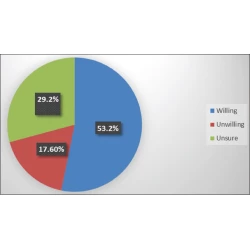
Introduction: Globally, there is a discrepancy between demand and availability of organs for transplantation. Transplantation is done from a living donor as well as a brain-dead/deceased donor. However, the World Health Organization (WHO) encourages deceased donor transplantation, since there is no risk to the donor. Although, the Transplant Act of Nepal 2016 opened the doors for deceased donor organ transplantation, the rate of transplantation from deceased donors is very low. Thus, this study assesses factors associated with willingness for deceased organ donation among post-graduate students of law, medicine, and mass communication streams. Methods: A total of 9 colleges, 3 from each specialty were selected via lottery method. The total sample size calculated was 440. A self-administered questionnaire was used to collect the data. 170, 140 and 130 forms were distributed in law, medicine and mass communication respectively via convenient sampling. Multivariate analysis among the variables that had p-value <0.05 in bivariate analysis was carried out to find out the strongest predictors of willingness to be a deceased organ donor. Results: In all, 53.2% were willing to become deceased organ donors. Family permission having someone in family with chronic disease, having attended any conference or general talk on organ donation, knowing a live organ donor, and knowing that body will not be left disfigured after organ extraction were found to be the strongest predictors for willingness to be deceased organ donor. Lack of awareness was reported as the main barrier. Conclusion: There is a need for extensive awareness programs and new strategies to motivate individuals and family members for organ donation.
Downloads
Similar Articles
- Gopal K Singh, Hyunjung Lee, Marked Disparities in COVID-19 Prevalence by Racial/Ethnic, Socioeconomic, Geographic, and Health Care Characteristics, United States, January – April, 2021 , Vol. 5 No. 2 (2021): The International Journal of Translational Medical Research and Public Health (IJTMRPH)
- Nsofwa Jubedah Mwansa, Victor Daka, David Mulenga, Ruth L Mfune, Bright Mukanga, Christopher Nyirenda, Seter Siziya, Correlates of Seizure Control Among Patients with Epilepsy at Two Referral Hospitals in Zambia , Vol. 4 No. 2 (2020): The International Journal of Translational Medical Research and Public Health (IJTMRPH)
- Amina P Alio, Linxi Liu, Kelly Thevenet-Morrison, Michelle R Rubado, Hugh F Crean, Peter J Veazie, Christopher L Seplaki, Ann Dozier, Association of Voluntary Legal Paternity and Breastfeeding Duration and Exclusivity in a Sample of Mothers in NewYork State, United States , Vol. 5 No. 2 (2021): The International Journal of Translational Medical Research and Public Health (IJTMRPH)
- Amina A. Umar, Yusuf D. Jobbi, Hassan Adam Murtala, Aisha Adam Abdullahi, Muktar H. Aliyu, Sani H. Aliyu, Eknath Naik, Ololade D. Adeyemi, Deepa Dongarwar, Hamisu M. Salihu, Socioeconomic and Clinical Determinants of Nutritional Phenotypes among Children with Sickle Cell Disease , Vol. 9 No. Continuous (2025): The International Journal of Translational Medical Research and Public Health (IJTMRPH)
- Leah Claus, Sara S Jarvis, Building Trust: Strategies for Recruiting Underrepresented Populations in Research during the COVID-19 Pandemic , Vol. 7 No. 1 (2023): The International Journal of Translational Medical Research and Public Health (IJTMRPH)
- Osman Nuri Yogurtcu, Laura E. Gressler, Jens Eldrup-Jorgensen, Kashif Haqqi, Colin Shepard, Orestis A. Panagiotou, Santiago J. Molina, Philip P. Goodney, Ali B. Abbasi, Brian S. Anderson, Wilbur C. Hadden, James E. Tcheng, Julia Skapik, Gregory Pappas, Building Real-World Evidence Infrastructure to Improve Health and Healthcare in the United States: Part II—How Coordinated Registry Networks Operate Like Systemic Coordinated Inter-Organizational Networks , Vol. 9 No. Special Collection (2025): The International Journal of Translational Medical Research and Public Health (IJTMRPH)
- Elizabeth A Armstrong-Mensah, Transitioning a Public Health Study Abroad Program to Virtual Format During the COVID-19 Pandemic: Implications for Public Health Practice , Vol. 6 No. 1 (2022): The International Journal of Translational Medical Research and Public Health (IJTMRPH)
- Samuel E Willis, Deepa Dongarwar, Jonnae O Atkinson, Jalyce Taylor, Derek L Lockett, Eunique L Williams, Hamisu M Salihu, Comparing Homicidal Ideations with Homicides/Assaults Victimization among Various Racial/Ethnic Groups in the United States , Vol. 5 No. 2 (2021): The International Journal of Translational Medical Research and Public Health (IJTMRPH)
- Ahmed A Bulama, Jane Goodman-Brown, Polio Eradication in Nigeria and India: A Systematic Review of Challenges and Successes , Vol. 3 No. 2 (2019): The International Journal of Translational Medical Research and Public Health (IJTMRPH)
- Elizabeth Armstrong-Mensah , Niha Mitha, Aireona McNair, The Mental Health of Syrian Refugees in the United States: Examining Critical Risk Factors and Major Barriers to Mental Health Care Access , Vol. 7 No. 1 (2023): The International Journal of Translational Medical Research and Public Health (IJTMRPH)
You may also start an advanced similarity search for this article.
Published
How to Cite
Issue
Section
License
Copyright © 2019 Pragya Paneru, Samyog Uprety, Shyam S Budhathoki, Birendra K Yadav, Suman L Bhandari. Published by Global Health and Education Projects, Inc., USA.

This is an open-access article distributed under the terms of the Creative Commons Attribution-NonCommercial-ShareAlike 4.0 International License , which permits others to remix, transform, and build upon the work non-commercially, provided the original author is credited and the new creations are licensed under the same terms.



 .
.

