
Polio Eradication in Nigeria and India: A Systematic Review of Challenges and Successes
DOI:
https://doi.org/10.21106/ijtmrph.92Keywords:
- Polio,
- Immunization,
- Nigeria,
- India,
- Pakistan,
- Eradication,
- Systematic Review
Abstract
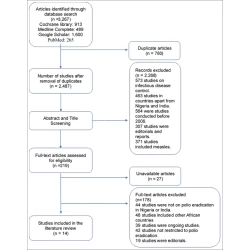
Background: The global eradication of polio is considered an emergency and an unaccomplished task until completely eliminated. Vaccinating children against the polio virus confers immunity on them and breaks the transmission of the polio virus. Afghanistan, Nigeria and Pakistan remain the only three countries in the world that have not eliminated polio. The aims of this paper were to: (1) to identify the factors that impact the failure to eliminate polio from Nigeria and (2) determine the factors that led to the successful elimination of polio from India. Methods: A systematic literature review was carried out to meet the above research objectives. Four electronic databases were searched (Cochrane Library, Medline, PubMed and Google Scholar) and articles that fulfilled the inclusion and exclusion criteria were selected and critically appraised. Results: In all, 98 articles were retrieved. After selection based on our selection criteria, fourteen studies were identified and included in the study. These were 5 systematic reviews: 3 cross-sectional studies, 3 mixed methods studies, 2 case-control studies and one quantitative (survey) study. In all, seven themes were identified from the review of the articles. Four themes were identified from the factors associated with the failure to eliminate polio from Nigeria: (1) Failure of the oral polio vaccine (OPV); (2) Institutional and geographical failures in vaccine programs; (3) Program and campaign management limitations; and (4) Vaccine refusal. Similarly, three themes were identified from the factors that contributed to the elimination of polio from India: (1) Replacement of the trivalent OPV with the monovalent and bivalent OPVs; (2) Implementation of intensive social mobilization strategies; and (3) Effective program micro planning and campaign management. Conclusion and Implications for Translation: Based on the findings from the literature review, we highlight areas where Nigeria can learn from India in its quest to eliminate polio. These factors can form the basis for future theoretical and policy reforms in the fight against polio not only in Nigeria but in countries where it remains endemic. Further research should compare the success of polio eradication in other countries.
Downloads
Similar Articles
- Dania Matta, Patti Herring, W. Lawrence Beeson, Seth Wiafe, The Role of Perceived Susceptibility, Perceived Severity, Perceived Barriers and Benefits in COVID-19 Vaccine Hesitancy and Uptake Among Outpatient Surgery Nurses in the United States: A Qualitative Study , Vol. 7 No. 1 (2023): The International Journal of Translational Medical Research and Public Health (IJTMRPH)
- Omar M Young, Jackyln C Fuller, Henry W Lewis III, An Innovative Approach to E-mentorship for Black Applicants to Graduate Medical Education (GME) Programs , Vol. 8 No. Continuous (2024): The International Journal of Translational Medical Research and Public Health (IJTMRPH)
- Elizabeth Armstrong Mensah, Maria Adjini, Bria Pringle-Weston, Akwasi Akosah, Rachael Addo, Late Dementia Diagnosis Among Elderly Minority Populations in the United States: Causes, Effects, and Addressing Inequities , Vol. 8 No. Continuous (2024): The International Journal of Translational Medical Research and Public Health (IJTMRPH)
- Gregory Pappas, Introduction to Special Collection: Building the Real-World Evidence Infrastructure to Accelerate Innovation and Improve Outcomes in Healthcare , Vol. 9 No. Special Collection (2025): The International Journal of Translational Medical Research and Public Health (IJTMRPH)
- Godefroid M.A Musema, Ali M Mapatano, Desire K Tshala, Patrick K Kayembe, HIV-1-Syphilis Co-infection Associated with High Viral Load in Female Sex Workers in the Democratic Republic of the Congo , Vol. 4 No. 1 (2020): The International Journal of Translational Medical Research and Public Health (IJTMRPH)
- Elizabeth Afibah Armstrong-Mensah, Ato Kwamena Tetteh, HIV Prevention in sub-Saharan Africa: Where Are Adolescents in the Continuum? , Vol. 5 No. 2 (2021): The International Journal of Translational Medical Research and Public Health (IJTMRPH)
- Fazal Dad, Tafara Ndumiyana, Aweke Kebede, Blessing Butaumocho, Anthony Muganza, Robert Ackatia Armah, Lidya Mitike, Mella Taban, Strengthening Rural Food Systems through the UN World Food Program’s Fresh Food Voucher in Ethiopia’s Somali Region: An Evaluation of Nutritional and Market Impacts , Vol. 10 (2026): The International Journal of Translational Medical Research and Public Health (IJTMRPH)
- Oluwasola Stephen Ayosanmi, Lorette Oden, Titilope Ayosanmi, Babatunde Alli, Mei Wen, Jamie Johnson, The Role of Health Belief Model in HIV Screening Decision among International Students in the United States: A Pilot Study , Vol. 4 No. 1 (2020): The International Journal of Translational Medical Research and Public Health (IJTMRPH)
- Bright Opoku Ahinkorah, Edward Kwabena Ameyaw, Abdul-Aziz Seidu, Sanni Yaya, Predictors of Female Genital Mutilation or Cutting Among Daughters of Women in Guinea, West Africa , Vol. 5 No. 1 (2021): The International Journal of Translational Medical Research and Public Health (IJTMRPH)
- Selina Khatun, Rafiqul Islam, Nazrul Islam Mondal, Nazrul Hoque, Clyde McNeil, Fatema Siddiqua, Sociodemographic Determinants of Early, Normal, and Delayed Menarche among Female College-Aged Students in Bangladesh , Vol. 1 No. 1 (2017): The International Journal of Translational Medical Research and Public Health (IJTMRPH)
<< < 3 4 5 6 7 8 9 10 11 12 > >>
You may also start an advanced similarity search for this article.
Published
How to Cite
Issue
Section
License
Copyright © 2019 Ahmed A Bulama, Jane Goodman-Brown. Published by Global Health and Education Projects, Inc., USA.

This is an open-access article distributed under the terms of the Creative Commons Attribution-NonCommercial-ShareAlike 4.0 International License , which permits others to remix, transform, and build upon the work non-commercially, provided the original author is credited and the new creations are licensed under the same terms.



 .
.

