
Quality and Safety Management of Health Care Service Delivery among Public Hospitals in Rwanda: a Cross-Sectional Survey
DOI:
https://doi.org/10.21106/ijtmrph.81Keywords:
- Quality and Safety Management,
- Health Care Service Delivery,
- Rwanda,
- Quality and Safety Score levels
Abstract
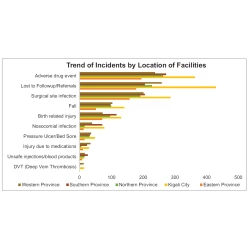
Background or Objectives: Quality and safety of health care service delivery remain a challenge worldwide due to unsafe care, inappropriate practices, adverse events and medication errors that result in harm, disability and death of patients. This study examines the status of quality and safety management of health care service delivery in public hospitals in Rwanda. Methods: The study was a descriptive cross-sectional study. Overall population of interest comprised of 564 hospital managers from 47 hospitals. An online email-based questionnaire was used for data collection. Statistical analysis included bivariate, multivariable, and logistic regression analyses with significance at p <0.05. Data were analyzed using Statistical Package for Social Sciences (IBM Corp. Released 2012. IBM SPSS Statistics for Windows, Version 21.0. Armonk, NY: IBM Corp.). Results: The study sample population was 235 managers (5 persons from each hospital). Of the 235 responses received, 72.3% were from male managers and 27.7% were from female managers. The prevalence of adverse events among public hospitals in Rwanda is 0.007% (p=0.02, 95% CI: 0.017-0.023) with risk of incidents of 0.073%. In all, 98.7% of public hospitals reported incidents, and only 39.3% of them have regularly reported all types of incidents. The most common incidents were adverse drug event (25.3%), loss to follow-up/referrals (25%), and surgical site infection (20%). Rwanda has 0.043 (IQR: 0.032-0.060) doctors per 1,000 population. The country also has 0.25 (IQR: 0.18-0.33) nurses per 1,000 population. The 76.5% of respondents reported that variation of consultation time is between 10-15 minutes (p=0.003, 95% CI: 0.002-0.004) which is associated with 0.12% risk of incidents. The public hospitals have on average 44.25 ± 13.46 SD consultations per clinician per day. More than a half of respondents 54.3% (p=0.033, 95%CI: 0.029- 0.036) reported that 10-20% of treatment given to patients were not needed and are significantly associated with high risk of incidents. The public hospitals score Level 1(documentation) (p=0.016, 95%CI: 0.014-0.019) for quality health care services delivery and, over half score Level 2(implementation). They also score Level 1(documentation) (p: 0.209, 95%CI: 0.201-0.216) for safe health care, and approximately half of them score Level 2(implementation). Conclusion and Implications for Translation: The quality and safety of health care services should be a priority for health care professionals and health care systems. The culture of blame and punishment is a challenge across hospitals. Reassuring adverse events reporting and learning from errors need to be emphasized and prioritized in public hospitals.
Downloads
Similar Articles
- Michael Quinn Patton, Laura Elisabeth Gressler, Sustainable, Cooperative, Inclusive, Organized Networks, and Translational Health: A Book Review of Saving Societies from Within: Innovation and Equity through Inter-Organizational Networks , Vol. 9 No. Special Collection (2025): The International Journal of Translational Medical Research and Public Health (IJTMRPH)
- Chongo Clays Siwale, Seter Siziya, Factors Associated with Alcohol Consumption Among Students in High-Cost Schools in Lusaka, Zambia , Vol. 3 No. 1 (2019): The International Journal of Translational Medical Research and Public Health (IJTMRPH)
- Pragya Paneru, Samyog Uprety, Shyam S Budhathoki, Birendra K Yadav, Suman L Bhandari, Willingness to Become Deceased Organ Donors among Post‑graduate Students in Selected Colleges in Kathmandu Valley, Nepal , Vol. 3 No. 1 (2019): The International Journal of Translational Medical Research and Public Health (IJTMRPH)
- Precious Okechukwu Eteike, Evangeline Tochi Oparaocha, Antimalarial Drug Efficacy of Artemether-Lumefantrine in Subclinical Malaria in Southeastern Nigeria , Vol. 1 No. 2 (2017): The International Journal of Translational Medical Research and Public Health (IJTMRPH)
- Lucrèce M Delicat-Loembet, A.D. Nno Mabiala, Ulrich Bisvigou, Eveline Avoune, Solange Bongo, André N’Tchoreret, Arnaud Kouoyo, Alain Ondo, Alexis E Dokekias, Jean Koko, Simon Ategbo, Diagnosis of Sickle Cell Disease in Gabon Using Sickle SCAN®: A Point-of-Care Blood Test , Vol. 6 No. 2 (2022): The International Journal of Translational Medical Research and Public Health (IJTMRPH)
- Samuel E Willis, Deepa Dongarwar, Jonnae O Atkinson, Jalyce Taylor, Derek L Lockett, Eunique L Williams, Hamisu M Salihu, Comparing Homicidal Ideations with Homicides/Assaults Victimization among Various Racial/Ethnic Groups in the United States , Vol. 5 No. 2 (2021): The International Journal of Translational Medical Research and Public Health (IJTMRPH)
- Soupriye B Zibima, Kenneth B Wasini, Juliet I Oniso, Disparities in Urban and Rural Dwelling Adolescents’ Educational Needs for Obesity Prevention in Nigeria , Vol. 4 No. 2 (2020): The International Journal of Translational Medical Research and Public Health (IJTMRPH)
- Fatima Usman, Zubairu Iliyasu, Hamisu M Salihu, Muktar H Aliyu, COVID-19 Pandemic and Medical Education in Nigeria , Vol. 5 No. 2 (2021): The International Journal of Translational Medical Research and Public Health (IJTMRPH)
- Ashok Bahadur Varma, Can the Internal Nasal Valves Method Be a Game Changer for Preventing Respiratory Tract Infections? , Vol. 8 No. Continuous (2024): The International Journal of Translational Medical Research and Public Health (IJTMRPH)
- Bushra Elbashir, Msab Al-dkheel, Hamad Aldakheel, Naif Aruwished, Nasser Alodayani, Hypertension in Saudi Arabia: Assessing Life Style and Attitudes , Vol. 4 No. 1 (2020): The International Journal of Translational Medical Research and Public Health (IJTMRPH)
<< < 7 8 9 10 11 12 13 14 15 > >>
You may also start an advanced similarity search for this article.
Published
How to Cite
Issue
Section
License
Copyright © 2019 Deogratias Ndagijimana, Connie Mureithi, Nicholas Njau Ngomi. Published by Global Health and Education Projects, Inc., USA.

This is an open-access article distributed under the terms of the Creative Commons Attribution-NonCommercial-ShareAlike 4.0 International License , which permits others to remix, transform, and build upon the work non-commercially, provided the original author is credited and the new creations are licensed under the same terms.



 .
.

