
Prevention Versus Treatment: Barriers to Tuberculosis Prevention and Treatment in Urban Areas
DOI:
https://doi.org/10.25259/IJTMRPH_23_2025Keywords:
- Preventive Medicine,
- Preventive Health Services,
- Preventive Programs,
- Preventive Care,
- Tuberculosis,
- Urban Health,
- Urban Health Services
Abstract
Tuberculosis preventive treatment (TPT) is thought to be one of the game changers of Tuberculosis (TB) elimination. The success of the TPT program lies in the coverage rate. Anecdotal evidence suggested that there are a few areas in West Bengal where TPT coverage is low. The study aimed to find the barriers to the TPT program in the urban TB units of a district in West Bengal.
Methods:This was a mixed-methods study. Quantitative data were collected and analyzed from the Nikshay portal, which is India’s TB information management portal. Qualitative data were collected through interviews with key informants, including doctors, paramedical staff, TB patients, and their household contacts (HHCs).
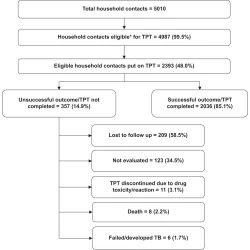
Results:Among the eligible HHCs, 48% were initiated with TPT. Of those who were initiated with TPT, 85.1% completed the treatment. The major reasons for unsuccessful outcomes were ‘lost to follow-up’ (58.5%) and ‘Not evaluated’ (34.5%). Refusal due to long duration of TPT, fear of side effects, lack of awareness, and stigma associated with TB were the main reasons for the poor TPT initiation rate. Poor adherence mechanisms, unaddressed adverse reactions, inadequate knowledge of health care workers, and migration of beneficiaries were the reasons for the poor TPT completion rate.
Conclusion and Implications for Translation:For TPT implementation in urban areas, there are a few unique challenges such as inadequate health workforce and infrastructure, impeding influence of the private sector, and population migration. Long duration of TPT was one of the most significant barriers that can be addressed by the availability of shorter TPT regimens across the age groups.
Downloads
Similar Articles
- Marilyn Murrillo, On Utilizing Artificial Intelligence to Impact Healthcare in Low-Income Countries , Vol. 8 No. Continuous (2024): The International Journal of Translational Medical Research and Public Health (IJTMRPH)
- Shivam Singh, Ashok Sharma, Richa Tripathi, Vitthal Govindappa Huddar, Subhash Gupta, Network Pharmacology and Preliminary in Vitro Evaluation of Piper longum (Indian Long Pepper) in Breast Cancer , Vol. 10 (2026): The International Journal of Translational Medical Research and Public Health (IJTMRPH)
- Jacklyn C Fuller, Mary C Ottolini, Motivators and Incentives of Pediatric Medical Educators in an Academic Hospital Setting in the United States , Vol. 2 No. 2 (2018): The International Journal of Translational Medical Research and Public Health (IJTMRPH)
- Hamisu M Salihu, Brisa Y Garcia, Deepa Dongarwar, Racial/Ethnic Disparities in Receipt of Lung Transplant and In-Hospital Mortality among Pediatric and Adolescent Patients in the United States , Vol. 5 No. 2 (2021): The International Journal of Translational Medical Research and Public Health (IJTMRPH)
- Terrie Cowley, Allen W. Cowley, Real-World Evidence: Why Are We Still Waiting? , Vol. 9 No. Special Collection (2025): The International Journal of Translational Medical Research and Public Health (IJTMRPH)
- Laila Al Afnan, Enhancing Hepatitis B Awareness and Risk Management in Barbershops and Salons: A Call for Tailored Interventions , Vol. 8 No. Continuous (2024): The International Journal of Translational Medical Research and Public Health (IJTMRPH)
- Faruqueuddin U. Ahmed, COVID-19 Pandemic and Medical Education in India , Vol. 5 No. 1 (2021): The International Journal of Translational Medical Research and Public Health (IJTMRPH)
You may also start an advanced similarity search for this article.
Published
How to Cite
Issue
Section
License
Copyright © 2025 Abhijit Dey, Rajat Basu, Poulami Basu; Simran Keshri; Bandita Sengupta, Sandip Roy. Published by Global Health and Education Projects, Inc., USA.

This is an open-access article distributed under the terms of the Creative Commons Attribution-NonCommercial-ShareAlike 4.0 International License , which permits others to remix, transform, and build upon the work non-commercially, provided the original author is credited and the new creations are licensed under the same terms.



 .
.

