
Compliance, Barriers, and Enhancers of WHO “Five Moments for Hand Hygiene” Among Healthcare Workers in Tanzania
DOI:
https://doi.org/10.25259/IJTMRPH_84_2024Keywords:
- Developing Countries,
- Five Moments for Hand Hygiene,
- Hand Hygiene,
- Healthcare-Acquired Infections,
- Misungwi
Abstract
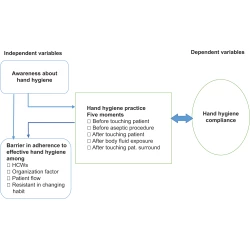
Nosocomial infections from inconsistent hand hygiene (HH) significantly increase morbidity, mortality, and healthcare costs globally. To address this, the World Health Organization (WHO) introduced the “Five Moments for Hand Hygiene” in 2009, emphasizing critical points for HH to prevent healthcare-associated infections. Despite its importance, compliance among healthcare workers (HCWs), particularly in resource-limited settings like Tanzania, remains challenging. This study assessed awareness and compliance with the “Five Moments” in Misungwi District Council.
Methods:This was a cross-sectional study design to assess HH compliance among HCWs in Misungwi District. A mixed-methods approach combined quantitative observations of compliance and qualitative surveys exploring barriers and enhancers. A multistage random sampling technique selected 154 participants from Comprehensive Emergency Obstetric Care (CEmOC) facilities. Data collection involved questionnaires and checklists. The Statistical Package for the Social Sciences was used to analyze sociodemographic and compliance data.
Results:The study revealed that a total of 154 participated, whereby the response rate was 33%, and most participants were female. The mean and mode age for participants were 39.05 and 34.5 years, respectively, but the age of 30–39 had the highest frequency. Furthermore, the study result showed that 95 (61.7%) had working experience between 5 and 10 years. HH awareness was low, with 53.9% answering fewer than three questions correctly. Compliance averaged 37.87%, with the highest adherence after touching body fluids (93.6%) and the lowest before touching patients (14.8%). Key barriers included lack of awareness (88.7%) and irregular water supply (84.8%), while guidelines (82.5%) and a suitable environment (77.5%) were key enhancers.
Conclusion and Implications for Translation:Based on the Five Moments HH awareness, compliance is low in Misungwi District CEmOC facilities, requiring targeted education, adequate resources, and barrier mitigation. Promoting a culture of HH can enhance compliance, reduce infections, and improve patient safety. A collaborative approach involving healthcare leaders, staff, and stakeholders is essential for sustainable improvements.
Downloads
Similar Articles
- Gopal K Singh, Hyunjung Lee, Romuladus E Azuine, Marked Inequalities in COVID-19 Vaccination by Racial/Ethnic, Socioeconomic, Geographic, and Health Characteristics, United States, January 6 – February 15, 2021 , Vol. 5 No. 2 (2021): The International Journal of Translational Medical Research and Public Health (IJTMRPH)
- Chika K. Onwuamah, Oliver C. Ezechi, Judith O. Sokei, Chinenye Angela Ogbu, Peter G. C. Odeigah, Association of Zidovudine or Nevirapine Treatment with Sperm Abnormalities Across Two Generations of Albino Mice , Vol. 10 (2026): The International Journal of Translational Medical Research and Public Health (IJTMRPH)
- Romuladus E Azuine, Gopal K Singh, Shanita D Williams, Evangeline T Oparaocha, Shiv C Mathur, Translating Public and Population Health Research into Policy and Actions: The International Journal of Translational Medical Research and Public Health (IJTMRPH) , Vol. 1 No. 1 (2017): The International Journal of Translational Medical Research and Public Health (IJTMRPH)
- Ernest Mutua, Okello B.M Agina, Isaac J Mwanzo, Prevalence and Correlates of Medication Non-adherence among Hypertensive Patients on Follow-up in Central Kenya , Vol. 7 No. 1 (2023): The International Journal of Translational Medical Research and Public Health (IJTMRPH)
- Angelique B Willis, Mildred Addo, Lauren E Yoder, Cassandra K Johnson, Sydney L Resler, Leticia J Young, Elizabeth Armstrong-Mensah, Individual and Community Level Factors Related to Sanitation, Water Quality, Treatment and Management in Rural Communities in Accra, Ghana: A Field Study Report , Vol. 6 No. 1 (2022): The International Journal of Translational Medical Research and Public Health (IJTMRPH)
- Lillian Lamba, Eustarckio Kazonga, Christopher Nyirenda, Rodgers Chilyabanyama, Viral Load Suppression Among Adults with HIV on Antiretroviral Therapy: Outcomes from a Lusaka District Hospital, Zambia , Vol. 9 No. Continuous (2025): The International Journal of Translational Medical Research and Public Health (IJTMRPH)
- Romuladus E. Azuine, Gopal K. Singh, Rowena C. Saplala, The Journey So Far: Welcoming Our New Editor and Journal Progress Report , Vol. 9 No. Special Collection (2025): The International Journal of Translational Medical Research and Public Health (IJTMRPH)
- Elisa J. Gordon, Zubairu Iliyasu, Elizabeth S. Rose, Fatimah I. Tsiga-Ahmed, Usman J. Wudil, Aishatu L. Adamu, C. William Wester, Muktar H. Aliyu, Building Capacity for the Ethical Conduct of Genetic and Genomic Research in Nigeria: The Vanderbilt-Nigeria Research Ethics Training Program , Vol. 9 No. Continuous (2025): The International Journal of Translational Medical Research and Public Health (IJTMRPH)
- Elizabeth Armstrong Mensah, Maria Adjini, Bria Pringle-Weston, Akwasi Akosah, Rachael Addo, Late Dementia Diagnosis Among Elderly Minority Populations in the United States: Causes, Effects, and Addressing Inequities , Vol. 8 No. Continuous (2024): The International Journal of Translational Medical Research and Public Health (IJTMRPH)
- Oluwatosin Olateju, Ilona Argirion, Melanie Bolden, Stephanie Klapper, Jonas Nguh, Chidubem Egboluche, Addressing Health Disparities in Maryland Communities: Insights from a Public Health State Affiliate and Strategic Advocacy Recommendations , Vol. 9 No. Continuous (2025): The International Journal of Translational Medical Research and Public Health (IJTMRPH)
<< < 2 3 4 5 6 7 8 9 10 11 > >>
You may also start an advanced similarity search for this article.
Published
How to Cite
Issue
Section
License
Copyright © 2025 Peter Chilipweli, Given Mwambope, Abubakar O. Abdallah, Patrick Mwakubo, Aneth Dunia. Published by Global Health and Education Projects, Inc., USA.

This is an open-access article distributed under the terms of the Creative Commons Attribution-NonCommercial-ShareAlike 4.0 International License , which permits others to remix, transform, and build upon the work non-commercially, provided the original author is credited and the new creations are licensed under the same terms.



 .
.

