
Building Real-World Evidence Infrastructure to Improve Health and Healthcare in the United States: Part III— Questions for Translational Science and Action Theory
DOI:
https://doi.org/10.25259/IJTMRPH_76_2024Keywords:
- Evidence-Based Medicine,
- Learning Health System,
- Public Health,
- Registries
Abstract
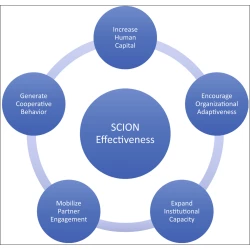
Background and Objective: Previous work in this series has introduced real-world evidence (RWE), coordinated registry networks (CRNs), and systemic, coordinated, inter-organizational networks (SCIONs) theory. The application of SCIONs theory to CRNs illuminates how their structure and function foster trust and cooperation in a network of organizations to successfully address complex problems in healthcare. This third part in the series asks questions about how SCIONs theory can benefit CRNs and how the experience of CRNs can further develop the SCIONs theory. Methods: This manuscript analyzes reciprocal relationships related to SCIONs theory and CRN practice, examining how each can be used to benefit the other. While SCIONs theory has not yet formally been used to direct the development of a CRN, future application is proposed. Conversely, we explored how the practical experiences of CRNs can inform and refine our understanding of SCIONs, including identifying areas for theoretical development and through an exploration of the current limitations of CRNs. Results: The SCIONs theory may usefully direct CRN development in key leadership areas, including increasing human capital, encouraging organizational adaptiveness, expanding institutional capacity, mobilizing political engagement, and generating cooperative behavior. CRNs, guided by SCIONs theory, can offer a pathway towards a more efficient, equitable, and learning-oriented healthcare system. A comprehensive approach proposed for CRNs may facilitate the expansion of the evaluation component in SCIONs theory. Conclusion and Implications for Translation: CRN program managers should prioritize strategic approaches that foster human capital, organizational adaptability, and institutional capacity. Government agencies may consider investments in CRN as a way to build RWE infrastructure that improves quality and efficiency of healthcare broadly. Public discourse may benefit from a clearer understanding of the role of cooperation in society to address issues that government and markets are not well suited to address. The literature on SCIONs can support the non-profit literature in the way the business literature supports the for-profit sector.
Downloads
Most read articles by the same author(s)
- Osman Nuri Yogurtcu, Laura E. Gressler, Jens Eldrup-Jorgensen, Kashif Haqqi, Colin Shepard, Orestis A. Panagiotou, Santiago J. Molina, Philip P. Goodney, Ali B. Abbasi, Brian S. Anderson, Wilbur C. Hadden, James E. Tcheng, Julia Skapik, Gregory Pappas, Building Real-World Evidence Infrastructure to Improve Health and Healthcare in the United States: Part I—Coordinated Registry Networks and Systemic Coordinated Inter-Organizational Networks , International Journal of Translational Medical Research and Public Health: Vol. 9 No. Special Collection (2025): The International Journal of Translational Medical Research and Public Health (IJTMRPH)
- Osman Nuri Yogurtcu, Laura E. Gressler, Jens Eldrup-Jorgensen, Kashif Haqqi, Colin Shepard, Orestis A. Panagiotou, Santiago J. Molina, Philip P. Goodney, Ali B. Abbasi, Brian S. Anderson, Wilbur C. Hadden, James E. Tcheng, Julia Skapik, Gregory Pappas, Building Real-World Evidence Infrastructure to Improve Health and Healthcare in the United States: Part II—How Coordinated Registry Networks Operate Like Systemic Coordinated Inter-Organizational Networks , International Journal of Translational Medical Research and Public Health: Vol. 9 No. Special Collection (2025): The International Journal of Translational Medical Research and Public Health (IJTMRPH)
- Gregory Pappas, Introduction to Special Collection: Building the Real-World Evidence Infrastructure to Accelerate Innovation and Improve Outcomes in Healthcare , International Journal of Translational Medical Research and Public Health: Vol. 9 No. Special Collection (2025): The International Journal of Translational Medical Research and Public Health (IJTMRPH)
Similar Articles
- Gopal K Singh, Mehrete Girmay, Michelle Allender, Christine T Ramey, Digital Divide: Marked Disparities in Computer and Broadband Internet Use and Associated Health Inequalities in the United States , Vol. 4 No. 1 (2020): The International Journal of Translational Medical Research and Public Health (IJTMRPH)
- Romuladus E. Azuine, Gopal K. Singh, Rowena C. Saplala, The Journey So Far: Welcoming Our New Editor and Journal Progress Report , Vol. 9 No. Special Collection (2025): The International Journal of Translational Medical Research and Public Health (IJTMRPH)
- John A Markson, Early Infant Diagnosis of HIV in Primary Health Care Centers , Vol. 5 No. 1 (2021): The International Journal of Translational Medical Research and Public Health (IJTMRPH)
- Esther Ayaaba, Yi Liu, Yan Li, Lei Han, Quansah Dan Yedu, Ni Chunhu, Measures to Control the Prevalence of Pneumoconiosis in Coal Mining: A Review of the Literature , Vol. 1 No. 1 (2017): The International Journal of Translational Medical Research and Public Health (IJTMRPH)
- Iddi Matovu, Miph Musoke, HIV Infection Among Adolescent Girls and Young Women in Sub-Saharan Africa: Philosophical Perspectives of Sociostructural Risk Factors , Vol. 8 No. Continuous (2024): The International Journal of Translational Medical Research and Public Health (IJTMRPH)
- Matiur Rahman, Md. Aminur Rahman, Md. Kaoser Bin Siddique, Md. Rahidul Islam, Mohammad Mahbub ur Rahim, Impact of COVID-19 on Essential Health Care of Rural People in Northern Bangladesh: A Cross-Sectional Study , Vol. 7 No. 1 (2023): The International Journal of Translational Medical Research and Public Health (IJTMRPH)
- Mayowa Jeremiah Adeniyi, Ayoola Awosika, Samuel Agaba Ameh, John Obogwu, Samuel Ijoganu, Phoebe Nwamaka Kanikwu, Impact of Short-Term Hot Water Hand Immersion on Physiological Responses to Different Orthostatic Durations , Vol. 10 (2026): The International Journal of Translational Medical Research and Public Health (IJTMRPH)
- Fazal Dad, Tafara Ndumiyana, Aweke Kebede, Blessing Butaumocho, Anthony Muganza, Robert Ackatia Armah, Lidya Mitike, Mella Taban, Strengthening Rural Food Systems through the UN World Food Program’s Fresh Food Voucher in Ethiopia’s Somali Region: An Evaluation of Nutritional and Market Impacts , Vol. 10 (2026): The International Journal of Translational Medical Research and Public Health (IJTMRPH)
- Moses M Gitonga, Kenneth K Ngure, Elizabeth E Echoka, Effectiveness of a Community Level Maternal Health Intervention in Improving Uptake of Postnatal Care in Migori County, Kenya , Vol. 3 No. 1 (2019): The International Journal of Translational Medical Research and Public Health (IJTMRPH)
- Mahendra Arnold, Sepali Wickramatilake, Palitha Karunapema, Dinusha Fernando, Roshan Sampath, Buddhika Mahesh, Sujeewa Panditharathna, Referral Outcomes of Identified Health Problems and Difficulties Related to School Medical Inspections in Government Schools in an Education Zone in Sri Lanka , Vol. 4 No. 1 (2020): The International Journal of Translational Medical Research and Public Health (IJTMRPH)
<< < 1 2 3 4 5 6 7 8 9 10 > >>
You may also start an advanced similarity search for this article.
Published
How to Cite
Issue
Section
License
Copyright © 2025 Osman Nuri Yogurtcu, Laura E Gressler, Jens Eldrup-Jorgensen, Kashif Haqqi, Colin Shepard, Orestis A Panagiotou, Santiago J Molina, Philip P Goodney, Ali B Abbasi, Brian S Anderson, Wilbur C Hadden, James E Tcheng, Julia Skapik, Gregory Pappas. Published by Global Health and Education Projects, Inc., USA.

This is an open-access article distributed under the terms of the Creative Commons Attribution-NonCommercial-ShareAlike 4.0 International License , which permits others to remix, transform, and build upon the work non-commercially, provided the original author is credited and the new creations are licensed under the same terms.



 .
.

