
Racial and Ethnic Disparities in the Mental Health Impact of the COVID-19 Pandemic in the United States: Analysis of 3 Million Americans from the National Health Interview Survey and Household Pulse Survey
DOI:
https://doi.org/10.21106/ijtmrph.417Keywords:
- COVID-19,
- Mental Health,
- Depression,
- Anxiety,
- Worry,
- Psychological Distress Index,
- Racial/Ethnic Disparity,
- Worsening Health Disparity
Abstract
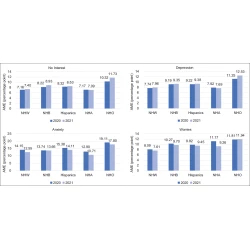
Background: During the coronavirus (COVID-19) pandemic, racial/ethnic minorities in the United States (US) experienced a disproportionate burden of COVID-19 mortality and hospitalization, job losses, food insecurity, and reduced healthcare access, resulting in increased mental health problems. Given heterogeneous findings on the impact of COVID-19 among racial/ethnic minorities, it is worthwhile to examine the differential effects of the pandemic on mental health by race/ethnicity. Methods: This study examines changes in mental health status among US adults aged ≥18 years before and during the pandemic. We pooled data from the 2019 National Health Interview Survey with the 2020-2021 Household Pulse Survey (N=2,980,511). Logistic regression was used for binary outcomes and linear regression was used for the composite Psychological Distress Index (PDI) measure derived from principal components analysis to estimate changes in mental health after controlling for sociodemographic characteristics. Results: Mental health status worsened during the pandemic compared to the pre-pandemic period. The adjusted predicted probabilities of having little interest increased from 3.29% in 2019 to 10.97% in 2020 and 11.28% in 2021. The adjusted predicted probabilities of being depressed increased from 2.69% in 2019 to 11.00% in 2020 and 11.21% in 2021. The adjusted predicted probabilities of feeling anxious increased from 3.95% in 2019 to 18.35% in 2020 and 16.96% in 2021. The adjusted predicted probabilities of worrying increased from 4.18% in 2019 to 13.15% in 2020 and 12.61% in 2021. The adjusted mean PDI score increased from 87.52 in 2019 to 103.18 in 2020 and 101.13 in 2021. In stratified models, Blacks, Hispanics, and Asians had higher odds of depression, anxiety, and worries, compared with non-Hispanic Whites. Asians experienced 10 times higher odds of depression and 15 times higher odds of anxiety in 2020 than their counterparts before the pandemic. Conclusions and Implications for Translation: US adults experienced a marked increase in mental health problems, including depression and anxiety, in 2020 and 2021, compared with their counterparts in 2019. Racial/ethnic disparities in mental health worsened during the pandemic.
Downloads
Most read articles by the same author(s)
- Mehrete Girmay, Gopal K Singh, Social Isolation, Loneliness, and Mental and Emotional Well-being among International Students in the United States , International Journal of Translational Medical Research and Public Health: Vol. 3 No. 2 (2019): The International Journal of Translational Medical Research and Public Health (IJTMRPH)
- Gopal K Singh, Shanita D Williams, Hyunjung Lee, Elijah K Martin, Michelle Allender, Christine T Ramey, Trends in Physical and Mental Health, Mortality, Life Expectancy, and Social Inequalities Among American Indians and Alaska Natives, 1990-2019 , International Journal of Translational Medical Research and Public Health: Vol. 5 No. 2 (2021): The International Journal of Translational Medical Research and Public Health (IJTMRPH)
- Romuladus E Azuine, Gopal K Singh, Shanita D Williams, Evangeline T Oparaocha, Shiv C Mathur, Translating Public and Population Health Research into Policy and Actions: The International Journal of Translational Medical Research and Public Health (IJTMRPH) , International Journal of Translational Medical Research and Public Health: Vol. 1 No. 1 (2017): The International Journal of Translational Medical Research and Public Health (IJTMRPH)
- Gopal K. Singh, Hyunjung Lee, Romuladus E. Azuine, Trends and Socioeconomic, Demographic, and Behavioral Determinants of Kidney Disease Prevalence among African Americans in the United States, 1997–2021 , International Journal of Translational Medical Research and Public Health: Vol. 9 No. Continuous (2025): The International Journal of Translational Medical Research and Public Health (IJTMRPH)
- Gopal K. Singh, Hyunjung Lee, Lyoung Hee Kim, Gem P Daus, Promoting Health Literacy as an Important Initiative in Reducing Health Disparities and Advancing Health Equity , International Journal of Translational Medical Research and Public Health: Vol. 8 No. Continuous (2024): The International Journal of Translational Medical Research and Public Health (IJTMRPH)
- Gopal K Singh, Mehrete Girmay, Michelle Allender, Christine T Ramey, Digital Divide: Marked Disparities in Computer and Broadband Internet Use and Associated Health Inequalities in the United States , International Journal of Translational Medical Research and Public Health: Vol. 4 No. 1 (2020): The International Journal of Translational Medical Research and Public Health (IJTMRPH)
- Gopal K Singh, Hyunjung Lee, Romuladus E Azuine, Food Insecurity among Lesbian, Gay, Bisexual, and Transgender Adults During the COVID-19 Pandemic in the United States, July-October 2021 , International Journal of Translational Medical Research and Public Health: Vol. 6 No. 1 (2022): The International Journal of Translational Medical Research and Public Health (IJTMRPH)
- Gopal K. Singh, Lyoung Hee Kim, Hyunjung Lee, Romuladus E Azuine, Disparities in Prevalence of COVID-19, Long COVID, Disease Severity, and Mental Health Outcomes among US Adults by Industrial Sector of Employment, September-November 2022 , International Journal of Translational Medical Research and Public Health: Vol. 7 No. 2 (2023): The International Journal of Translational Medical Research and Public Health (IJTMRPH)
- Hyunjung Lee, Gopal K Singh, Marked Disparities in Cardiovascular Disease Mortality by Levels of Happiness and Life Satisfaction in the United States , International Journal of Translational Medical Research and Public Health: Vol. 4 No. 2 (2020): The International Journal of Translational Medical Research and Public Health (IJTMRPH)
- Gopal K Singh, Hyunjung Lee, Romuladus E Azuine, Growing Job-Related Income Losses, Increasing Social Inequalities, and Physical and Mental Health Impact During the COVID-19 Pandemic, United States, April – December 2020 , International Journal of Translational Medical Research and Public Health: Vol. 5 No. 2 (2021): The International Journal of Translational Medical Research and Public Health (IJTMRPH)
Similar Articles
- Gopal K. Singh, Lyoung Hee Kim, Hyunjung Lee, Romuladus E Azuine, Disparities in Prevalence of COVID-19, Long COVID, Disease Severity, and Mental Health Outcomes among US Adults by Industrial Sector of Employment, September-November 2022 , Vol. 7 No. 2 (2023): The International Journal of Translational Medical Research and Public Health (IJTMRPH)
- Gopal K. Singh, Hyunjung Lee, Lyoung Hee Kim, Romuladus E Azuine, State and Metropolitan Area Disparities in Long COVID-19 and Related Symptoms among US Adults, June-October 2022 , Vol. 7 No. 2 (2023): The International Journal of Translational Medical Research and Public Health (IJTMRPH)
- Gopal K Singh, Hyunjung Lee, Gem P Daus, Prevalence and Sociodemographic and Behavioral Correlates of Psychological Distress among Lesbian, Gay, and Bisexual Adults in the United States, 2013-2018 , Vol. 6 No. 1 (2022): The International Journal of Translational Medical Research and Public Health (IJTMRPH)
- Gopal K Singh, Shanita D Williams, Hyunjung Lee, Elijah K Martin, Michelle Allender, Christine T Ramey, Trends in Physical and Mental Health, Mortality, Life Expectancy, and Social Inequalities Among American Indians and Alaska Natives, 1990-2019 , Vol. 5 No. 2 (2021): The International Journal of Translational Medical Research and Public Health (IJTMRPH)
- Ajoke Olutola Adagbada, Jacob Itopa Yisau, Toun Wuraoluwa Fesobi, Muinah Adenike Fowora, Tajudeen Akanji Bamidele, Toyosi Yekeen Raheem, Adenike Shola Aiyedogbon, Ibilola Omolopo, Abraham Ajayi, Olufemi Samuel Amoo, Chinonso Ikpo, Grace Abosede Akintunde, Bamidele Abiodun Iwalokun, Stella Ifeanyi Smith, Babatunde Lawal Salako, Community-acquired Klebsiella pneumoniae – Its Virulence and Antimicrobial Resistance Genes Complement in Participants Presenting for COVID-19 Testing in Lagos State, Nigeria , Vol. 10 (2026): The International Journal of Translational Medical Research and Public Health (IJTMRPH)
- Osman Nuri Yogurtcu, Laura E Gressler, Jens Eldrup-Jorgensen, Kashif Haqqi, Colin Shepard, Orestis A Panagiotou, Santiago J Molina, Philip P Goodney, Ali B Abbasi, Brian S Anderson, Wilbur C Hadden, James E Tcheng, Julia Skapik, Gregory Pappas, Building Real-World Evidence Infrastructure to Improve Health and Healthcare in the United States: Part III— Questions for Translational Science and Action Theory , Vol. 9 No. Special Collection (2025): The International Journal of Translational Medical Research and Public Health (IJTMRPH)
- Gopal K Singh, Hyunjung Lee, Romuladus E Azuine, Increasing Trends in Physical and Mental Health Problems among US Workers in Different Job Sectors During the COVID-19 Pandemic , Vol. 5 No. 2 (2021): The International Journal of Translational Medical Research and Public Health (IJTMRPH)
- Gopal K Singh, Hyunjung Lee, Romuladus E Azuine, Growing Job-Related Income Losses, Increasing Social Inequalities, and Physical and Mental Health Impact During the COVID-19 Pandemic, United States, April – December 2020 , Vol. 5 No. 2 (2021): The International Journal of Translational Medical Research and Public Health (IJTMRPH)
- Elizabeth Armstrong-Mensah , Niha Mitha, Aireona McNair, The Mental Health of Syrian Refugees in the United States: Examining Critical Risk Factors and Major Barriers to Mental Health Care Access , Vol. 7 No. 1 (2023): The International Journal of Translational Medical Research and Public Health (IJTMRPH)
- Gopal K. Singh, Hyunjung Lee, Lyoung Hee Kim, Gem P Daus, Promoting Health Literacy as an Important Initiative in Reducing Health Disparities and Advancing Health Equity , Vol. 8 No. Continuous (2024): The International Journal of Translational Medical Research and Public Health (IJTMRPH)
You may also start an advanced similarity search for this article.
Published
How to Cite
Issue
Section
License
Copyright © 2022 Hyunjung Lee, Gopal K Singh. Published by Global Health and Education Projects, Inc., USA.

This is an open-access article distributed under the terms of the Creative Commons Attribution-NonCommercial-ShareAlike 4.0 International License , which permits others to remix, transform, and build upon the work non-commercially, provided the original author is credited and the new creations are licensed under the same terms.



 .
.

