
Levels, Trends, and Causes of Adolescent and Young Adult Maternal Mortality in Nigeria During 1990–2017: Analysis of the 2017 Global Burden of Disease Study Database
DOI:
https://doi.org/10.21106/ijtmrph.414Keywords:
- Maternal Mortality,
- Nigeria,
- Ratio,
- Rate,
- Adolescent,
- Young Adult,
- GBD,
- Trend
Abstract
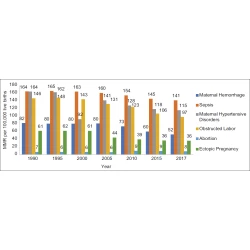
Background: Despite the global progress made in reducing maternal mortality in the past two decades, the health of adolescents and young adult women (10-24 years) has been neglected based on the wrong assumption that they are healthy, especially in a developing country like Nigeria; this is despite the fact that adolescents and young adults (AYA) constitute over 16% of Nigeria’s population. Thus, this study aimed to determine the levels, trends, and causes of maternal mortality among AYA women aged 10-24 years in Nigeria. Methods: This was a cross-sectional study that utilized secondary data sets running from 1990 to 2017 from the Global Burden of Disease Study’s (GBD) online interactive tool downloaded from the Global Health Data Exchange (GHDx) platform. From the database, we extracted the numbers of maternal deaths (10-49 years), adolescent and young adults’ maternal deaths (10-24 years), the proportion of maternal deaths (10-24 years), and both maternal mortality ratio and rate for 15- 49 years old and 10-24 years old in the form of Comma separated values (CSV) and converted into XLS file in Microsoft (MS) Excel format for the analysis. Frequencies, proportions, and charts were generated using MS Excel. Result: A total of 122,107 maternal deaths occurred among adolescents and young adults (AYA), which is 26% of all deaths occurring among 10-49 years old. Year-to-year changes in the absolute numbers of maternal deaths among AYA showed that it ranged from 3,866 (1990) to 4,451 (2017), showing a slight upward increase over the period; however, both AYA maternal mortality ratio and rate show consistent declines over the period. AYA maternal mortality ratio (MMR) for adolescents aged 15-19 years was 17% higher than for young adults aged 20-24 years. Sepsis was the leading cause of adolescent maternal death (MMR of 168), followed by maternal hypertensive disorder, obstructed labor, maternal hemorrhage, ectopic pregnancy, and abortion. A total of 460,155 maternal deaths occurred in women aged 10-49 years during the study period. Maternal deaths in the age group 10-24 years ranged from 3,866 (29.8%) in 1990 to 4,451 (25.1%) in 2017. The maternal mortality ratio in women aged 10-49 years declined by about 30% for the 1990 – 2017 period. Conclusion and Implications for Translation: The study showed that adolescents and young adults are at increased risk of maternal deaths in Nigeria. Therefore, multi-faceted maternal health programs in the country need to target this age group to prevent maternal deaths
Downloads
Similar Articles
- Selina Khatun, Rafiqul Islam, Nazrul Islam Mondal, Nazrul Hoque, Clyde McNeil, Fatema Siddiqua, Sociodemographic Determinants of Early, Normal, and Delayed Menarche among Female College-Aged Students in Bangladesh , Vol. 1 No. 1 (2017): The International Journal of Translational Medical Research and Public Health (IJTMRPH)
- Harlem J Gunness, Striking Differences in Physical and Mental/Behavioral Health Status Between Homeless Bisexual and Gay Young Men in New York City, United States , Vol. 4 No. 1 (2020): The International Journal of Translational Medical Research and Public Health (IJTMRPH)
- Vinod K Ramani, Radheshyam Naik, A Narrative Review of the Pathophysiology of Mucormycosis Infection Among COVID-19 Patients in India: Epidemiology and Clinical Implications , Vol. 6 No. 1 (2022): The International Journal of Translational Medical Research and Public Health (IJTMRPH)
- Chongo Clays Siwale, Seter Siziya, Factors Associated with Alcohol Consumption Among Students in High-Cost Schools in Lusaka, Zambia , Vol. 3 No. 1 (2019): The International Journal of Translational Medical Research and Public Health (IJTMRPH)
- Deepa Dongarwar, Hamisu M Salihu, COVID-19 Vaccination Rates by Global Universal Health Care Coverage Status , Vol. 5 No. 1 (2021): The International Journal of Translational Medical Research and Public Health (IJTMRPH)
- Osman Nuri Yogurtcu, Laura E Gressler, Jens Eldrup-Jorgensen, Kashif Haqqi, Colin Shepard, Orestis A Panagiotou, Santiago J Molina, Philip P Goodney, Ali B Abbasi, Brian S Anderson, Wilbur C Hadden, James E Tcheng, Julia Skapik, Gregory Pappas, Building Real-World Evidence Infrastructure to Improve Health and Healthcare in the United States: Part III— Questions for Translational Science and Action Theory , Vol. 9 No. Special Collection (2025): The International Journal of Translational Medical Research and Public Health (IJTMRPH)
- Maureen Atieno Adoyo, Yeri M Kombe, Gestational Diabetes Mellitus and Associated Health Risk Outcomes in Mothers and Neonates , Vol. 4 No. 1 (2020): The International Journal of Translational Medical Research and Public Health (IJTMRPH)
- Ahmad Bashir Umar, Mohammed Kabir Saleh, Yahuza Mansur Adamu, Sadiq Hassan, Muktar Hassan Aliyu, Anas Ismail, Ocular Health Complications Among People Living with HIV/AIDS in Nigeria: Leveraging Doppler Ultrasonography to Identify and Manage Risk Factors , Vol. 9 No. Continuous (2025): The International Journal of Translational Medical Research and Public Health (IJTMRPH)
- Fatima Usman, Zubairu Iliyasu, Hamisu M Salihu, Muktar H Aliyu, COVID-19 Pandemic and Medical Education in Nigeria , Vol. 5 No. 2 (2021): The International Journal of Translational Medical Research and Public Health (IJTMRPH)
- Ashok Bahadur Varma, Can the Internal Nasal Valves Method Be a Game Changer for Preventing Respiratory Tract Infections? , Vol. 8 No. Continuous (2024): The International Journal of Translational Medical Research and Public Health (IJTMRPH)
<< < 2 3 4 5 6 7 8 9 10 11 > >>
You may also start an advanced similarity search for this article.
Published
How to Cite
Issue
Section
License
Copyright © 2022 Tukur Dahiru, Awawu G Nmadu, Adegboyega M Oyefabi, Clement Woje, Bilkisu Nwankwo, Zainab K Muhammad-Idris. Published by Global Health and Education Projects, Inc., USA.

This is an open-access article distributed under the terms of the Creative Commons Attribution-NonCommercial-ShareAlike 4.0 International License , which permits others to remix, transform, and build upon the work non-commercially, provided the original author is credited and the new creations are licensed under the same terms.



 .
.

