
Diagnosis of Sickle Cell Disease in Gabon Using Sickle SCAN®: A Point-of-Care Blood Test
DOI:
https://doi.org/10.21106/ijtmrph.315Keywords:
- Sickle Cell Disease,
- Phenotypic Diagnosis,
- Sickle SCAN®,
- Capillary Electrophoresis,
- Gabon
Abstract
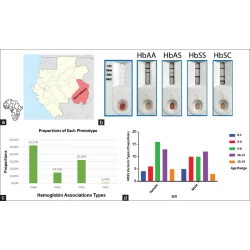
Background: Sickle cell disease (SCD) is the world’s most common genetic blood disorder. Most infant deaths from SCD occur in sub-Saharan Africa, and the mortality rate is exceptionally high in Gabon in Central Africa. In Gabon, there are limited resources for early and accurate detection of sickle cell or trait conditions. Most affected individuals reside in low-resource areas where access to diagnostic testing is often very limited. The most commonly used diagnostic methods require trained staff, adequate infrastructure, electric power, and enough time to perform the analysis. These requirements do not currently allow mass screening to be performed in remote areas of Gabon. The purpose of this pilot study is to develop a standardized screening procedure for SCD in order to determine its prevalence in the southeast area of Gabon by using a rapid and reliable test that does not require significant resources, such as the Sickle SCAN® device. Methods: The accuracy of the Sickle SCAN® device was assessed based on testing 272 blood samples. The exact hemoglobin was identified in 100% of the samples. The test comprises three proprietary indicators that detect the presence of hemoglobin A, S, and C, thus allowing the user to rapidly distinguish between normal (HbAA, N=142), carrier (HbAS, N=41), and sickle cell disease (HbSS, N=88; HbSC, N=1) samples. Hemoglobin variants (S and C) were confirmed by capillary electrophoresis (MinicapR; Sebia). The sensitivity and specificity were calculated for each phenotype. Results: The Sickle SCAN® test analysis revealed the following normal and abnormal phenotypes, including sickle cell trait (HbAS=14,71%) and SCD [HbSS (32.35%) and HbSC (0,74)]. There are no false positives in Sickle SCAN® result for the presence of hemoglobin variant, compared to gold standard approaches to capillary electrophoresis. The estimated sensitivity of the Sickle Scan® test was 92.2%, 100%, and 100% for HbSS, HbAS, and HbSC, respectively. The specificity exceeded 88.23% for all phenotypes (HbSS, HbAS, and HbSC). Conclusion and Implications for Translation:The Sickle Scan® device was found to be reliable with a sensitivity of 92.2%, 100%, and 100% for HbSS, HbAS, and HbSC, respectively. The specificity exceeded 88% for all phenotypes.
Downloads
Similar Articles
- Sorochi Iloanusi, Osaro Mgbere, Nchebe-Jah R Iloanusi, Ismaeel Yunusa, Ekere J Essien, COVID-19 Related Misconceptions and Prevention Practices Among Residents of a Populous Commercial City in Nigeria , Vol. 5 No. 2 (2021): The International Journal of Translational Medical Research and Public Health (IJTMRPH)
- Ahmed A Bulama, Jane Goodman-Brown, Polio Eradication in Nigeria and India: A Systematic Review of Challenges and Successes , Vol. 3 No. 2 (2019): The International Journal of Translational Medical Research and Public Health (IJTMRPH)
- Samuel E Willis, Deepa Dongarwar, Jonnae O Atkinson, Jalyce Taylor, Derek L Lockett, Eunique L Williams, Hamisu M Salihu, Comparing Homicidal Ideations with Homicides/Assaults Victimization among Various Racial/Ethnic Groups in the United States , Vol. 5 No. 2 (2021): The International Journal of Translational Medical Research and Public Health (IJTMRPH)
- Oluwasola Stephen Ayosanmi, Lorette Oden, Titilope Ayosanmi, Babatunde Alli, Mei Wen, Jamie Johnson, The Role of Health Belief Model in HIV Screening Decision among International Students in the United States: A Pilot Study , Vol. 4 No. 1 (2020): The International Journal of Translational Medical Research and Public Health (IJTMRPH)
- Tukur Dahiru, Awawu G Nmadu, Adegboyega M Oyefabi, Clement Woje, Bilkisu Nwankwo, Zainab K Muhammad-Idris, Levels, Trends, and Causes of Adolescent and Young Adult Maternal Mortality in Nigeria During 1990–2017: Analysis of the 2017 Global Burden of Disease Study Database , Vol. 6 No. 2 (2022): The International Journal of Translational Medical Research and Public Health (IJTMRPH)
- Elizabeth Armstrong-Mensah, Ato Kwamena Tetteh, Gifty Rhodalyn Tetteh, COVID-19 Pandemic: Face Mask Mandates, Hospitalization, and Infection Rates in the United States , Vol. 5 No. 2 (2021): The International Journal of Translational Medical Research and Public Health (IJTMRPH)
- Musa M Dogara, Saadatu Ahmad, Babalola J Balogun, Salwa S Dawaki, Muzammil B Mustapha, Aminu U Abdurrahman, Lawal Bala, Abubakar Zakari, David U Livingstone, Schistosomiasis and Associated Risk Factors Among School-Aged Children in Northern Nigeria , Vol. 4 No. 2 (2020): The International Journal of Translational Medical Research and Public Health (IJTMRPH)
- Amani A Alrehaili, Lumbar Puncture in Saudi Arabia: Knowledge, Awareness, Acceptance and its Refusal Among Health Professionals , Vol. 4 No. 1 (2020): The International Journal of Translational Medical Research and Public Health (IJTMRPH)
- Ernest Mutua, Okello B.M Agina, Isaac J Mwanzo, Prevalence and Correlates of Medication Non-adherence among Hypertensive Patients on Follow-up in Central Kenya , Vol. 7 No. 1 (2023): The International Journal of Translational Medical Research and Public Health (IJTMRPH)
- Nicholas A Sleeman, Carol Hoban, Samer Koutoubi, Sexually Transmitted Infections in Pre-Exposure Prophylaxis Patients , Vol. 7 No. 2 (2023): The International Journal of Translational Medical Research and Public Health (IJTMRPH)
<< < 1 2 3 4 5 6 7 8 9 10 > >>
You may also start an advanced similarity search for this article.
Published
How to Cite
Issue
Section
License
Copyright © 2022 Lucrèce M Delicat-Loembet, A.D. Nno Mabiala, Ulrich Bisvigou, Eveline Avoune, Solange Bongo, André N’Tchoreret, Arnaud Kouoyo, Alain Ondo, Alexis E Dokekias, Jean Koko, Simon Ategbo. Published by Global Health and Education Projects, Inc., USA.

This is an open-access article distributed under the terms of the Creative Commons Attribution-NonCommercial-ShareAlike 4.0 International License , which permits others to remix, transform, and build upon the work non-commercially, provided the original author is credited and the new creations are licensed under the same terms.



 .
.

