
Association Between Source of Treatment and Quality of Childhood Diarrhea Management Among Under-Five Children in Nigeria
DOI:
https://doi.org/10.21106/ijtmrph.372Keywords:
- Childhood Diarrhea,
- Childhood Illnesses,
- Quality of Care,
- Under-Five Mortality,
- Nigeria
Abstract
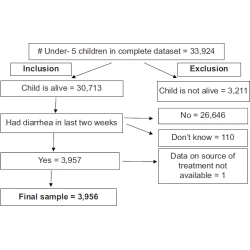
Background and Objective: Despite the availability of low-cost and effective interventions, diarrhea remains one of the leading causes of under-five morbidity and mortality in Nigeria. We assessed the relationships between the source and quality of treatment for children with diarrhea in Nigeria. Methods: We analyzed cross-sectional data on 3,956 under-five children with a recent diarrheal episode, from the 2018 Nigeria Demographic and Health Survey. The outcome was quality of diarrhea management based on the administration of the following treatment recommendations: oral rehydration salt (ORS), zinc supplementation, increased oral fluids, and continued feeding. The exposure was the source of treatment (none; traditional/informal; public hospitals/health centers; private hospitals/clinics; and community-based services). Using adjusted, multivariable logistic regression, we estimated the odds ratio (OR) and 95% confidence intervals (CI) to predict the factors related to the quality of diarrhea management. Results: In all, only 1 in 5 children received all the four recommended diarrhea interventions. The odds of good quality diarrhea management were higher among children who received treatment in public hospitals/ health centers, private hospitals/clinics, and community-based services compared to those of children who did not receive treatment (OR=2.52, 95% CI=1.89-3.34; OR=2.46, 95% CI=1.90-3.16; and OR=1.91, 95% CI=1.40-2.59, respectively). Compared to children whose parents did not seek treatment, the odds of receiving ORS ranged from 2.1 times (OR: 2.11, 95% CI=1.44-3.11) for seeking care in traditional/informal sources to 12.3 times (95% CI=8.81-17.15) in public hospitals/health centers. We observed similar trends for zinc supplementation. The odds of increased oral fluids were higher in public and private hospitals/clinics (OR=1.44, 95% CI=1.03-2.01 and OR=2.08, 95% CI=1.57-2.76, respectively). Across all settings, the odds of continued feeding were significantly lower among children who received treatment compared to children who did not receive treatment. Conclusion and Implications for Translation: Our findings indicate poor quality diarrhea management across various treatment settings. Policies and programs that encourage caregivers to seek treatment and improve the quality of care may contribute to reducing childhood diarrhea-related morbidity and mortality in Nigeria.
Downloads
Similar Articles
- Ekidor Ateyo Lokorio, Isaac Mwanzo, Gordon Ogweno, Voluntary Medical Male Circumcision Services and Related Psychosocial Factors Among Men in Kenya , Vol. 8 No. Continuous (2024): The International Journal of Translational Medical Research and Public Health (IJTMRPH)
- Marilyn Murrillo, On Utilizing Artificial Intelligence to Impact Healthcare in Low-Income Countries , Vol. 8 No. Continuous (2024): The International Journal of Translational Medical Research and Public Health (IJTMRPH)
- Faruqueuddin U. Ahmed, COVID-19 Pandemic and Medical Education in India , Vol. 5 No. 1 (2021): The International Journal of Translational Medical Research and Public Health (IJTMRPH)
- Deepa Dongarwar, Brisa Y Garcia, Sitratullah O Maiyegun, Korede K Yusuf, Hamisu M Salihu, COVID-19 Early Vaccination Rates and Gross Domestic Product Per Capita , Vol. 5 No. 1 (2021): The International Journal of Translational Medical Research and Public Health (IJTMRPH)
- Elizabeth Armstrong-Mensah, Ato Kwamena Tetteh, Gifty Rhodalyn Tetteh, COVID-19 Pandemic: Face Mask Mandates, Hospitalization, and Infection Rates in the United States , Vol. 5 No. 2 (2021): The International Journal of Translational Medical Research and Public Health (IJTMRPH)
You may also start an advanced similarity search for this article.
Published
How to Cite
Issue
Section
License
Copyright © 2021 Comfort Z Olorunsaiye, Hannah M Degge, Jiana Saigh. Published by Global Health and Education Projects, Inc., USA.

This is an open-access article distributed under the terms of the Creative Commons Attribution-NonCommercial-ShareAlike 4.0 International License , which permits others to remix, transform, and build upon the work non-commercially, provided the original author is credited and the new creations are licensed under the same terms.



 .
.

