
Identifying Risk Factors and Spatial Clustering of HIV Infection Among Female Sex Workers in India
DOI:
https://doi.org/10.21106/ijtmrph.145Keywords:
- Female Sex Worker,
- Kriged Map,
- Factor Analysis,
- Principle Component Analysis,
- HIV,
- Sexually Transmitted Infections
Abstract
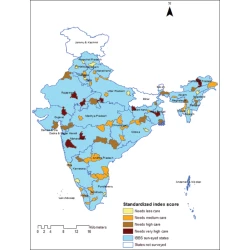
Background: The human immunodeficiency virus (HIV) epidemic in India is generally considered to be more concentrated, with the focus on high-risk groups including female sex workers (FSWs). The Integrated Biological and Behavioral Surveillance (IBBS), the first nationwide surveillance conducted during 2014-2015, collected many key indicators, including indicators related to HIV/STI transmission. The purpose of this study was to develop an index score for each domain surveyed and to identify focus areas for interventions among FSWs. Methods: The study population consisted of 27,007 FSWs. Forty high-risk related covariates of HIV/STI transmission, demographic characteristics, sexual history, condom practices, knowledge of HIV/STI and biological variables were considered. The original data set was examined using the correlation matrix and was reduced to 15 highly-correlated factors using principal component analysis. The factors were further improved using varimax rotation and the percentage of variation was used as weights to obtain the initial score for each domain, which were then standardized for comparison. Bartlett’s test of sphericity was examined before the factor extraction. Results: Six factors were extracted, which together explained about 73% of the total variation. The factors were: (1) more number of clients; (2) younger FSW and started selling sex at younger age; (3) experiencing condom breakage; (4) having occasional clients and poor HIV/AIDS knowledge; (5) illiteracy; and (6) a longer period of sex work. Six domains with an index score of above 80, from the states of Maharashtra, Rajasthan, Arunachal Pradesh, Uttar Pradesh, and Jharkhand need greater intervention. Conclusion and Implications for Translation: FSWs’ current age, age at commencement of sex work, and the number of clients were the indicators most-associated with HIV infection. Therefore, program and policy interventions should focus on FSWs who are younger than 10 clients.
Downloads
Similar Articles
- Godefroid M.A Musema, Ali M Mapatano, Desire K Tshala, Patrick K Kayembe, HIV-1-Syphilis Co-infection Associated with High Viral Load in Female Sex Workers in the Democratic Republic of the Congo , Vol. 4 No. 1 (2020): The International Journal of Translational Medical Research and Public Health (IJTMRPH)
- Chika K. Onwuamah, Oliver C. Ezechi, Judith O. Sokei, Chinenye Angela Ogbu, Peter G. C. Odeigah, Association of Zidovudine or Nevirapine Treatment with Sperm Abnormalities Across Two Generations of Albino Mice , Vol. 10 (2026): The International Journal of Translational Medical Research and Public Health (IJTMRPH)
- Shivam Singh, Ashok Sharma, Richa Tripathi, Vitthal Govindappa Huddar, Subhash Gupta, Network Pharmacology and Preliminary in Vitro Evaluation of Piper longum (Indian Long Pepper) in Breast Cancer , Vol. 10 (2026): The International Journal of Translational Medical Research and Public Health (IJTMRPH)
- Iddi Matovu, Miph Musoke, HIV Infection Among Adolescent Girls and Young Women in Sub-Saharan Africa: Philosophical Perspectives of Sociostructural Risk Factors , Vol. 8 No. Continuous (2024): The International Journal of Translational Medical Research and Public Health (IJTMRPH)
- Marilyn Murrillo, Improved Healthcare Access Would Save Millions of Lives in Africa , Vol. 10 (2026): The International Journal of Translational Medical Research and Public Health (IJTMRPH)
- Hamisu M. Salihu, Aisha A. Abdullahi, Hassan A. Murtala, Amina Aminu, Muhammad A. Abbas, Abubakar L. Yusuf, Muktar H. Aliyu, Sani H. Aliyu, Ololade D. Adeyemi, Deepa Dongarwar, Jordi B. Torrelles, Gambo Aliyu, Predictors of Human Immunodeficiency Virus (HIV) Acquisition among Children 0–14 Years in Nigeria , Vol. 9 No. Continuous (2025): The International Journal of Translational Medical Research and Public Health (IJTMRPH)
- Cameran M Mosley, Emmanuel Ofori, Caylin E Andrews, Elizabeth Armstrong-Mensah, Individual and Community Level Factors Related to HIV Diagnosis, Treatment, and Stigma in Kumasi, Ghana: A Field Report , Vol. 6 No. 1 (2022): The International Journal of Translational Medical Research and Public Health (IJTMRPH)
- Chisara Sylvestina Okolo, Adeola Olanrewaju Oluboyo, Celine Ijeoma Okolo, Akinloye Bankole Oyetunde, Ifeoma Evelyn Ezeukwu, Sickle Cell Disease (SCD) and Blood Transfusion: Prevalence of Alloantibodies and Red Cell Antigens among Multiply Transfused Individuals with SCD in Selected Tertiary Health Institutions in Abuja, Nigeria , Vol. 10 (2026): The International Journal of Translational Medical Research and Public Health (IJTMRPH)
- Ajoke Olutola Adagbada, Jacob Itopa Yisau, Toun Wuraoluwa Fesobi, Muinah Adenike Fowora, Tajudeen Akanji Bamidele, Toyosi Yekeen Raheem, Adenike Shola Aiyedogbon, Ibilola Omolopo, Abraham Ajayi, Olufemi Samuel Amoo, Chinonso Ikpo, Grace Abosede Akintunde, Bamidele Abiodun Iwalokun, Stella Ifeanyi Smith, Babatunde Lawal Salako, Community-acquired Klebsiella pneumoniae – Its Virulence and Antimicrobial Resistance Genes Complement in Participants Presenting for COVID-19 Testing in Lagos State, Nigeria , Vol. 10 (2026): The International Journal of Translational Medical Research and Public Health (IJTMRPH)
- Oluwasola Stephen Ayosanmi, Lorette Oden, Titilope Ayosanmi, Babatunde Alli, Mei Wen, Jamie Johnson, The Role of Health Belief Model in HIV Screening Decision among International Students in the United States: A Pilot Study , Vol. 4 No. 1 (2020): The International Journal of Translational Medical Research and Public Health (IJTMRPH)
You may also start an advanced similarity search for this article.
Published
How to Cite
Issue
Section
License
Copyright © 2021 Arumugam Elangovan, Vasna Joshua, Aridoss Santhakumar, Balasubramanian Ganesh, Nagaraj Jaganathasamy, Joseph K David, Malathi Mathiyazhakan, Manikandan Natesan, VM Padmapriya, Pradeep Kumar. Published by Global Health and Education Projects, Inc., USA.

This is an open-access article distributed under the terms of the Creative Commons Attribution-NonCommercial-ShareAlike 4.0 International License , which permits others to remix, transform, and build upon the work non-commercially, provided the original author is credited and the new creations are licensed under the same terms.



 .
.

