
Identifying Risk Factors and Spatial Clustering of HIV Infection Among Female Sex Workers in India
DOI:
https://doi.org/10.21106/ijtmrph.145Keywords:
- Female Sex Worker,
- Kriged Map,
- Factor Analysis,
- Principle Component Analysis,
- HIV,
- Sexually Transmitted Infections
Abstract
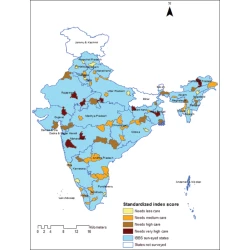
Background: The human immunodeficiency virus (HIV) epidemic in India is generally considered to be more concentrated, with the focus on high-risk groups including female sex workers (FSWs). The Integrated Biological and Behavioral Surveillance (IBBS), the first nationwide surveillance conducted during 2014-2015, collected many key indicators, including indicators related to HIV/STI transmission. The purpose of this study was to develop an index score for each domain surveyed and to identify focus areas for interventions among FSWs. Methods: The study population consisted of 27,007 FSWs. Forty high-risk related covariates of HIV/STI transmission, demographic characteristics, sexual history, condom practices, knowledge of HIV/STI and biological variables were considered. The original data set was examined using the correlation matrix and was reduced to 15 highly-correlated factors using principal component analysis. The factors were further improved using varimax rotation and the percentage of variation was used as weights to obtain the initial score for each domain, which were then standardized for comparison. Bartlett’s test of sphericity was examined before the factor extraction. Results: Six factors were extracted, which together explained about 73% of the total variation. The factors were: (1) more number of clients; (2) younger FSW and started selling sex at younger age; (3) experiencing condom breakage; (4) having occasional clients and poor HIV/AIDS knowledge; (5) illiteracy; and (6) a longer period of sex work. Six domains with an index score of above 80, from the states of Maharashtra, Rajasthan, Arunachal Pradesh, Uttar Pradesh, and Jharkhand need greater intervention. Conclusion and Implications for Translation: FSWs’ current age, age at commencement of sex work, and the number of clients were the indicators most-associated with HIV infection. Therefore, program and policy interventions should focus on FSWs who are younger than 10 clients.
Downloads
Similar Articles
- Pragya Paneru, Samyog Uprety, Shyam S Budhathoki, Birendra K Yadav, Suman L Bhandari, Willingness to Become Deceased Organ Donors among Post‑graduate Students in Selected Colleges in Kathmandu Valley, Nepal , Vol. 3 No. 1 (2019): The International Journal of Translational Medical Research and Public Health (IJTMRPH)
- Bright Opoku Ahinkorah, Abdul-Aziz Seidu, Eugene Budu, Ebenezer Kwesi Armah-Ansah, Ebenezer Agbaglo, Collins Adu, Edward Kwabena Ameyaw, Sanni Yaya, Factors Associated with Utilization of Postnatal Care Services in Mali, West Africa Bright Opoku Ahin , Vol. 5 No. 1 (2021): The International Journal of Translational Medical Research and Public Health (IJTMRPH)
- Amani A Alrehaili, Lumbar Puncture in Saudi Arabia: Knowledge, Awareness, Acceptance and its Refusal Among Health Professionals , Vol. 4 No. 1 (2020): The International Journal of Translational Medical Research and Public Health (IJTMRPH)
- Tukur Dahiru, Awawu G Nmadu, Adegboyega M Oyefabi, Clement Woje, Bilkisu Nwankwo, Zainab K Muhammad-Idris, Levels, Trends, and Causes of Adolescent and Young Adult Maternal Mortality in Nigeria During 1990–2017: Analysis of the 2017 Global Burden of Disease Study Database , Vol. 6 No. 2 (2022): The International Journal of Translational Medical Research and Public Health (IJTMRPH)
- Musa M Dogara, Saadatu Ahmad, Babalola J Balogun, Salwa S Dawaki, Muzammil B Mustapha, Aminu U Abdurrahman, Lawal Bala, Abubakar Zakari, David U Livingstone, Schistosomiasis and Associated Risk Factors Among School-Aged Children in Northern Nigeria , Vol. 4 No. 2 (2020): The International Journal of Translational Medical Research and Public Health (IJTMRPH)
- Betregiorgis Zegeye, Nicholas Kofi Adjei, Bright Opoku Ahinkorah, Edward Kwabena Ameyaw, Eugene Budu, Abdul-Aziz Seidu, Dina Idriss-Wheeler, Sanni Yaya, Barriers and Facilitators to Accessing Health Care Services among Married Women in Ethiopia: a Multi-level Analysis of the Ethiopia Demographic and Health Survey , Vol. 5 No. 2 (2021): The International Journal of Translational Medical Research and Public Health (IJTMRPH)
- Judith Eberhardt, Jonathan Ling, A Qualitative Exploration of Perceptions of the COVID-19 Vaccine in the United Kingdom During the Later Stages of the Vaccine Rollout , Vol. 6 No. 1 (2022): The International Journal of Translational Medical Research and Public Health (IJTMRPH)
- Caroline Okeke, Evangeline T Oparaocha, Book of Abstracts: 3rd International Congress on Health Sciences and Technology, School of Health Technology, Federal University of Technology Owerri, Nigeria, 8-11 August, 2018 , Vol. 2 No. S1 (2018): The International Journal of Translational Medical Research and Public Health (IJTMRPH)
- Deogratias Ndagijimana, Connie Mureithi, Nicholas Njau Ngomi, Quality and Safety Management of Health Care Service Delivery among Public Hospitals in Rwanda: a Cross-Sectional Survey , Vol. 3 No. 2 (2019): The International Journal of Translational Medical Research and Public Health (IJTMRPH)
- Esther Ayaaba, Yi Liu, Yan Li, Lei Han, Quansah Dan Yedu, Ni Chunhu, Measures to Control the Prevalence of Pneumoconiosis in Coal Mining: A Review of the Literature , Vol. 1 No. 1 (2017): The International Journal of Translational Medical Research and Public Health (IJTMRPH)
<< < 2 3 4 5 6 7 8 9 10 11 > >>
You may also start an advanced similarity search for this article.
Published
How to Cite
Issue
Section
License
Copyright © 2021 Arumugam Elangovan, Vasna Joshua, Aridoss Santhakumar, Balasubramanian Ganesh, Nagaraj Jaganathasamy, Joseph K David, Malathi Mathiyazhakan, Manikandan Natesan, VM Padmapriya, Pradeep Kumar. Published by Global Health and Education Projects, Inc., USA.

This is an open-access article distributed under the terms of the Creative Commons Attribution-NonCommercial-ShareAlike 4.0 International License , which permits others to remix, transform, and build upon the work non-commercially, provided the original author is credited and the new creations are licensed under the same terms.



 .
.

